
A one word domain is a domain name in which the entire second-level label – the segment positioned between the protocol and the top-level domain (TLD) extension – consists of a single, indivisible lexical unit, whether that unit is a dictionary word (e.g., zoom.com), a coined neologism (e.g., stripe.com), or a morphologically constructed brandable term. The classification is purely structural: the second-level domain contains no hyphens, spaces, compound connectors, or additional word tokens. This structural criterion directly governs valuation, brand authority, recall velocity, and type-in traffic potential, making the definitional boundary between “one word” and “multi-word” one of the most commercially significant distinctions in the domain name industry.
Understanding what is a one word domain goes far beyond a simple character count. The way you define it shapes every decision that follows – from acquisition strategy to brand positioning to the price you pay or receive at resale.
If you are actively searching for one-word domain names for sale, the precision of this definition will save you from costly misclassifications and help you identify genuinely premium assets.
What is a One Word Domain: The Technical Definition
At its core, a domain name has three structural components:
- The protocol (e.g.,
https://) - The second-level domain (SLD) – the part you register and own
- The top-level domain (TLD) – the extension (
.com,.io,.net, etc.)
When industry professionals, investors, and brand strategists say “one word domain,” they refer exclusively to the second-level domain consisting of exactly one word unit.
Consider these examples:
apple.com– the SLD isapple– one word. Qualifies.hotmail.com– the SLD ishotmail(a portmanteau of “hotline” + “mail”) – one constructed unit. Qualifies.mailchimp.com– the SLD ismailchimp– two recognizable words blended. This is debated.getresponse.com– the SLD isgetresponse– two distinct words concatenated without a hyphen. Does NOT qualify under the strict definition.
That last distinction matters enormously in both valuation and branding discussions, as we will explore throughout this article.
The Three Sub-Categories Within the One Word Definition
Not every one word domain is the same. Professionals in the domain industry typically recognize three sub-categories:
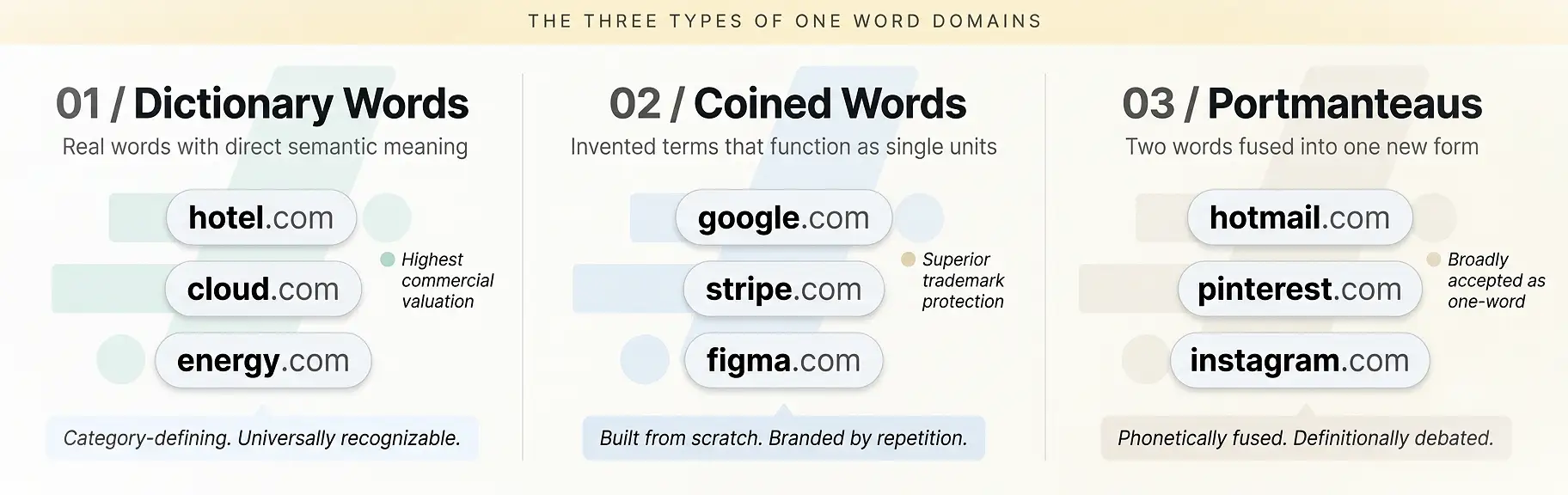
1. Generic Dictionary Words These are real, searchable English (or other language) words with clear semantic meaning. Examples: hotel.com, cloud.com, energy.com. These carry the highest valuation due to category-defining commercial appeal.
2. Coined or Invented Words (Neologisms) These are words that have no prior dictionary definition but are constructed to sound like a single, natural word unit. Examples: google.com, stripe.com, figma.com. They qualify as one word domains because they function as a single indivisible token.
3. Morphological Compounds (Portmanteaus) These blend two existing words into a single new form where the seam is phonetically or visually obscured. Examples: hotmail.com, pinterest.com, instagram.com. Their classification as “one word” is broadly accepted in the branding world, though purist domain investors often treat them differently for valuation purposes.
Why the Definition of a One Word Domain Matters Commercially
This is not a semantic argument. The boundary between “one word” and “two words written without a space” carries real financial weight.
According to DN.org’s analysis of one-word .com economics, one-word .com domains are considered the pinnacle of digital assets due to their simplicity, memorability, and unparalleled brand potential – frequently commanding six to seven-figure sale prices. Two-word concatenated domains, by contrast, occupy an entirely different market tier.
Here is why the distinction drives value:
- Cognitive load: A true single lexical unit reduces the mental effort required to recall a domain. The brain processes it as one item, not two.
- Type-in traffic: Users who remember a one word brand can navigate directly, bypassing search engines entirely. This generates zero-cost, high-intent traffic.
- Brand authority signals: Search engines and users alike associate short, single-word domains with established, authoritative entities.
- Resale liquidity: In domain investing, genuine one word .com domains sell faster and at higher price points than any other category, as noted by domain experts at NameExperts.
The “Hyphen Test”: A Practical Rule for Classification
One of the most reliable ways to classify a domain is what practitioners informally call the hyphen test:
If inserting a hyphen between any two characters of the SLD creates two recognizable words, the domain is likely a two-word concatenation rather than a true one word domain.
Apply the test:
| DOMAIN | HYPHEN TEST RESULT | CLASSIFICATION |
|---|---|---|
| zoom.com | zo-om – no meaningful split | True one word |
| stripe.com | st-ripe – no common split | True one word |
| getresponse.com | get-response – two clear words | Two-word concatenation |
| mailchimp.com | mail-chimp – two words, but blended | Portmanteau / disputed |
| snapchat.com | snap-chat – two clear words | Two-word concatenation |
| hotmail.com | hot-mail – two words, phonetically fused | Portmanteau / broadly accepted as one |
This test is not absolute, but it gives you a fast, consistent framework for evaluating whether a domain truly qualifies under the premium “one word” definition.
One Word Domain vs. Multi-Word Domain: A Full Comparison
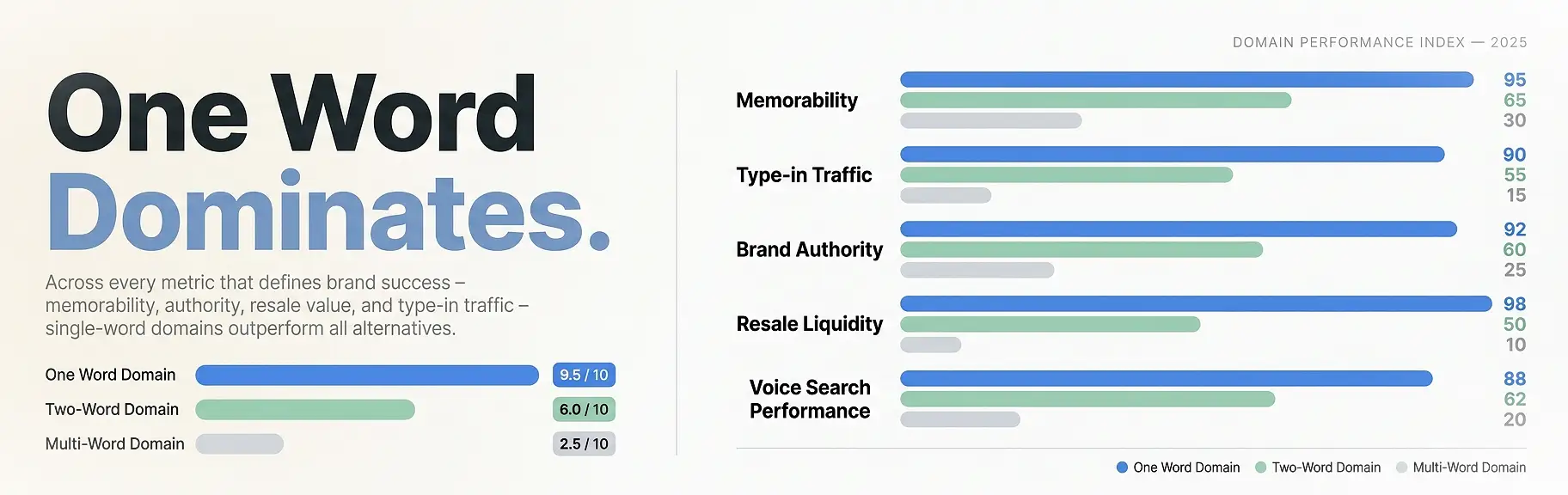
Understanding what is a one word domain becomes clearer when you compare it directly against longer alternatives across key performance dimensions.
Comparison Table: One Word Domain vs. Two-Word vs. Multi-Word Domain
| CRITERIA | ONE WORD DOMAIN | TWO-WORD DOMAIN | MULTI-WORD DOMAIN |
|---|---|---|---|
| Memorability | Excellent | Good | Poor |
| Type-in Traffic Potential | Very High | Moderate | Low |
| Brand Authority Perception | Premium | Mid-tier | Commodity |
| Average .com Resale Value | $50K – $30M+ | $500 – $50K | $50 – $500 |
| Keyword Flexibility | High (abstract) | Moderate | Low (over-specific) |
| Spelling Error Risk | Low | Moderate | High |
| Voice Search Performance | Excellent | Good | Poor |
| Trademark Registration Ease | Easier (coined words) | Moderate | Difficult |
The data makes a compelling case. Across nearly every metric that matters to brand builders and domain investors, the single-word asset outperforms its longer counterparts.
The TLD Dimension: Does the Extension Change the Classification?
A common point of confusion is whether the TLD affects the “one word” classification. The answer is no – and yes, depending on context.
Structurally: The TLD has no bearing on whether the SLD qualifies as one word. cloud.io, cloud.ai, and cloud.com all have a one word SLD. The classification remains consistent.
Commercially: The TLD dramatically affects value. The .com extension retains an overwhelming authority premium, and within the one word domain category, .com assets are valued far above the same word on any other extension.
For context, consider ICANN’s registry data, which shows .com as the world’s largest and most trusted TLD by a significant margin – a status that directly amplifies the value of any one word SLD registered under it.
The practical takeaway for buyers: a one word .net or .io is still a one word domain by definition, but it does not carry the same premium positioning as its .com equivalent.
Why One Word Domains Are Finite and Why That Scarcity Matters
The English language contains roughly 170,000 words in current active use, according to Oxford English Dictionary estimates. However, the commercially viable subset – words that are:
- Easy to pronounce in multiple languages
- Free from negative connotations globally
- Applicable across multiple industries
- Short enough for strong recall (ideally under 8 characters)
…numbers in the low thousands at best.
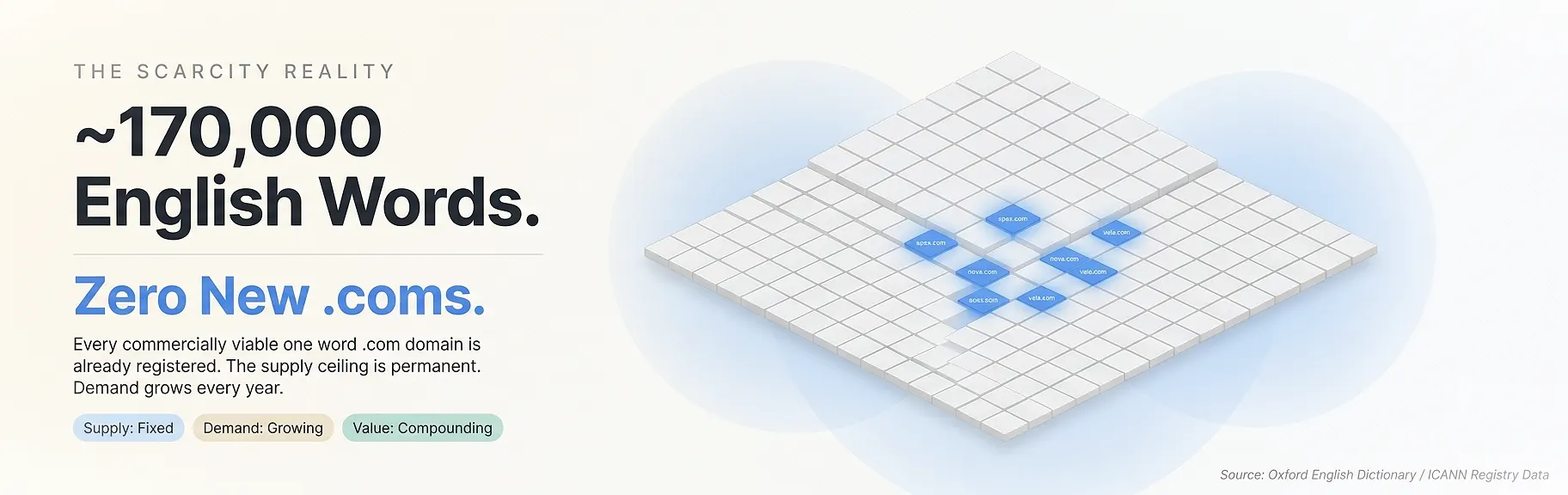
Every single one of those commercially viable words under the .com extension is already registered. There will never be new inventory of generic one word .com domains. This absolute supply ceiling is why the market behaves differently from virtually every other asset class in the digital economy.
Key scarcity dynamics to understand:
- No new supply: Once registered, a domain can only transfer ownership – it cannot be re-created.
- Corporate concentration: Large corporations and institutional investors hold most of the premium inventory.
- Increasing demand: As more businesses move online globally, the pool of buyers for premium single-word assets grows continuously.
- Appreciation trajectory: Unlike most digital assets, the scarcity-demand dynamic of one word .com domains supports long-term value appreciation.
This is precisely why investing in one-word domain names at the right moment – before a specific word gains mainstream commercial momentum – represents one of the most asymmetric opportunities in digital asset acquisition.
Common Mistakes People Make When Identifying One Word Domains
Even experienced buyers make classification errors. Here are the most frequent mistakes and how to avoid them:
Mistake 1: Treating Concatenated Words as One Word Domains
nextdoor.com, salesforce.com, and facebook.com are all two-word compounds written without a space. They are not one word domains in the strict definitional sense. Their brand success is extraordinary, but they do not trade in the same premium category.
How to avoid it: Apply the hyphen test. If two distinct words emerge, it is a compound – not a single-word asset.
Mistake 2: Ignoring the SLD vs. TLD Boundary
Some buyers conflate the full domain string with the SLD. The word count applies only to the second-level label – the part before the first dot.
How to avoid it: Strip the TLD mentally. go.to has a one word SLD (go). goto.com has a one word SLD (goto). Evaluate only what sits between the protocol and the first dot.
Mistake 3: Assuming All Short Domains Are One Word Domains
a1.com is short but it is not a word. abc.com is an acronym, not a word. Character length and word status are independent criteria.
How to avoid it: Check whether the SLD constitutes a recognizable word unit – dictionary word, coined term, or accepted neologism – not just a short string.
Mistake 4: Discounting Coined Words as “Not Real” Domains
google, zappos, and zillow were all invented words at the time of registration. Today, they are among the most valuable brands in the world. Coined one word domains qualify fully under the definition and often offer superior trademark protection.
How to avoid it: Evaluate coined words on phonetic appeal, memorability, and brandability – not on whether they appear in a dictionary.
Expert Tips for Evaluating a One Word Domain Before You Buy
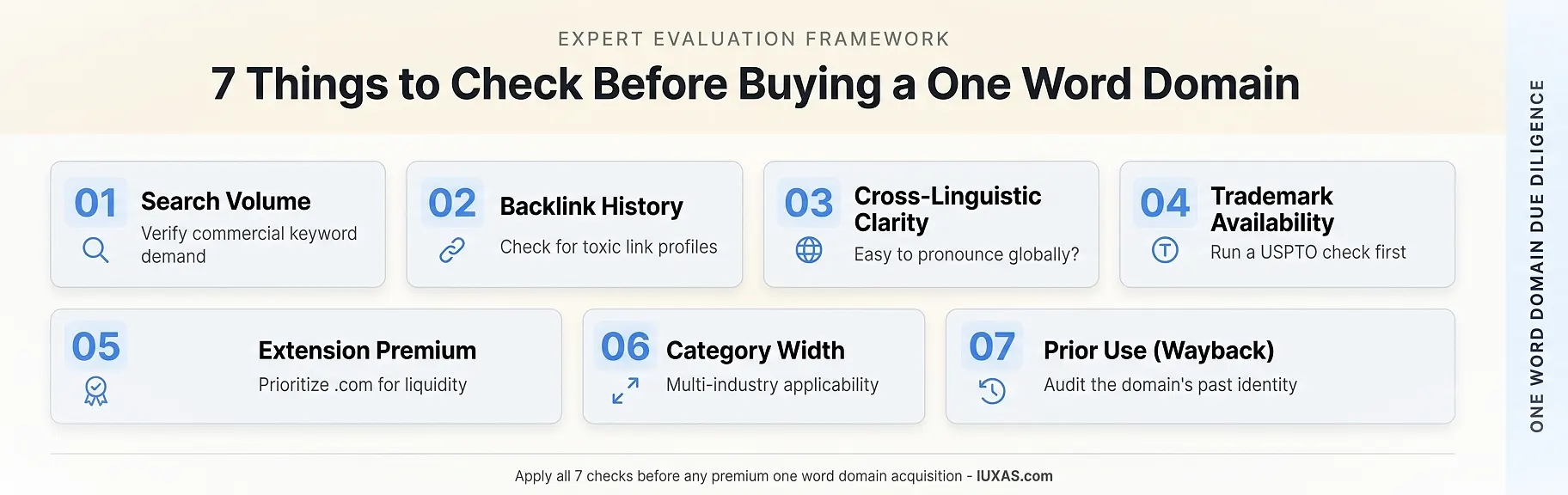
Whether you are building a brand or building a portfolio, these evaluation criteria will help you move beyond the basic definition and assess real-world asset quality:
- Check search volume: Use Google Keyword Planner to verify that the word carries organic search demand relevant to a commercial vertical.
- Audit the backlink history: Tools like Ahrefs or Moz can reveal whether a domain has a clean link profile or a toxic history from previous use.
- Assess cross-linguistic clarity: A word that is easy to pronounce and positive in meaning across major world languages carries broader commercial appeal.
- Verify trademark availability: Run a USPTO trademark search before acquiring any generic word domain intended for a specific commercial use.
- Confirm the extension premium: Prioritize
.comfor maximum liquidity and authority; evaluate.io,.ai, and.coas secondary positions in high-growth verticals. - Evaluate category width: Words that apply across multiple industries (e.g.,
apex,summit,core) carry higher liquidity than hyper-specific terms. - Check for prior use: Search the Wayback Machine to understand what the domain was previously used for and whether any brand equity – or liability – was built on it.
The Brand Impact of Getting This Right
The world’s most recognized brands almost universally occupy one word positions. Apple, Google, Amazon, Zoom, Stripe, Slack, Nike, and Uber are all single lexical units that now define entire categories of human activity.
This is not a coincidence. These companies understood – intuitively or strategically – that owning one word in the public consciousness is the ultimate competitive moat. A one word domain is the digital infrastructure that makes that ownership concrete.
When a brand lives at a single-word URL, several compounding advantages activate simultaneously:
- Zero navigational ambiguity: Users never need to guess at spelling or structure.
- Verbal brand equity: The domain can be spoken aloud in any context and immediately understood.
- SEO authority signals: A clean, authoritative SLD contributes to perceived domain authority across search algorithms.
- Investor confidence: Institutional investors and acquirers treat one word .com ownership as a signal of category leadership.
How to Find and Acquire One Word Domain Names for Sale
Because all generic one word .com domains are registered, acquisition requires a secondary market approach. Here is a practical step-by-step process:
Step 1: Define your word criteria Identify the semantic territory you want to own. Are you looking for a generic noun, an invented brandable term, or a category-defining verb? Clarity here narrows your search significantly.
Step 2: Search specialized marketplaces General domain registrars rarely carry premium one word inventory. Specialist platforms and curated portfolios are the most reliable source.
Step 3: Evaluate asset quality Apply the evaluation criteria outlined above: search volume, backlink health, linguistic clarity, TLD premium, and trademark status.
Step 4: Assess fair market value Review comparable sales data (known as “comps” in the domain industry) to understand what similar one word assets have sold for recently.
Step 5: Initiate acquisition Contact the listed seller directly or work through a broker. For high-value assets, escrow services protect both parties during the transaction.
Step 6: Transfer and verify Confirm full registrar transfer, update WHOIS records, and verify DNS propagation before treating the acquisition as complete.
For a curated selection of premium one-word domain names for sale, IUXAS offers a carefully assembled portfolio of single-word assets across multiple TLDs – making step two significantly faster for serious buyers.
Quick Reference: One Word Domain Definition Summary
For featured snippet purposes, here is a concise summary:
What is a one word domain?
A one word domain is a domain name where the second-level domain (SLD) – the part you register, between the https:// and the .com – consists of a single word unit. That unit can be:
- A real dictionary word (
hotel.com) - A coined/invented word (
google.com) - A portmanteau/blended word (
hotmail.com)
It does NOT include:
- Two words written without a space (
getresponse.com) - Acronyms or alphanumeric strings (
a1.com) - Hyphenated compounds (
best-hotel.com)
The TLD extension does not affect the classification.
Frequently Asked Questions About What Is a One Word Domain
What is a one word domain in simple terms?
A one word domain is a web address where the registerable part – the section before the .com or other extension – is a single word. That word can be a real dictionary term or an invented brand name, as long as it functions as one indivisible unit.
Is facebook.com a one word domain?
Under the strict professional definition, no. “Facebook” is a compound of “face” and “book” – two recognizable English words joined without a space. It classifies as a two-word concatenation, not a one word domain. However, because the blend is now so deeply embedded in global consciousness, many practitioners informally treat it as a single brand token.
Does the TLD (.com vs. .io) affect whether a domain is “one word”?
No. The TLD does not change the structural classification. A one word SLD paired with .io, .ai, or .net is still a one word domain. However, the TLD significantly affects commercial value, with .com commanding the highest premium in every market study.
Why are one word domains more valuable than multi-word domains?
One word domains are more valuable because they are finite in supply, cognitively easier to remember, faster to type, more effective in voice search, and more credible as brand identifiers. These advantages translate directly into higher type-in traffic, stronger brand authority, and greater resale liquidity.
Can an invented word qualify as a one word domain?
Yes. Coined or invented words – like google, stripe, or zillow – fully qualify as one word domains. They often carry additional value because they are easier to trademark than generic dictionary words, offering dual protection as both a domain asset and a registered brand.
What is a one word domain worth?
Value varies enormously based on word type, TLD, and commercial applicability. Generic one word .com domains regularly sell for six to seven figures. Coined one word .com domains for strong brands have sold for tens of millions. Niche one word domains on alternative TLDs may sell for four to five figures.
Where can I find one word domain names for sale?
Specialist domain marketplaces carry the most reliable premium inventory. IUXAS.com maintains a curated portfolio of single-word domain assets. Always verify asset quality, backlink history, and TLD premium before any acquisition.
The Definition is the Foundation
Understanding exactly what is a one word domain is not a pedantic exercise. It is the foundation of every smart decision you make in this asset class – whether you are building a brand, investing in digital real estate, or advising a startup on its online identity.
The definition is structural: one indivisible lexical unit in the second-level domain position. The implications, however, are enormous: premium brand authority, compounding scarcity value, superior recall, and a direct shortcut to category leadership in any industry you choose to enter.
The brands that dominate their markets did not get there by accident. They claimed one word. They built empires on it.
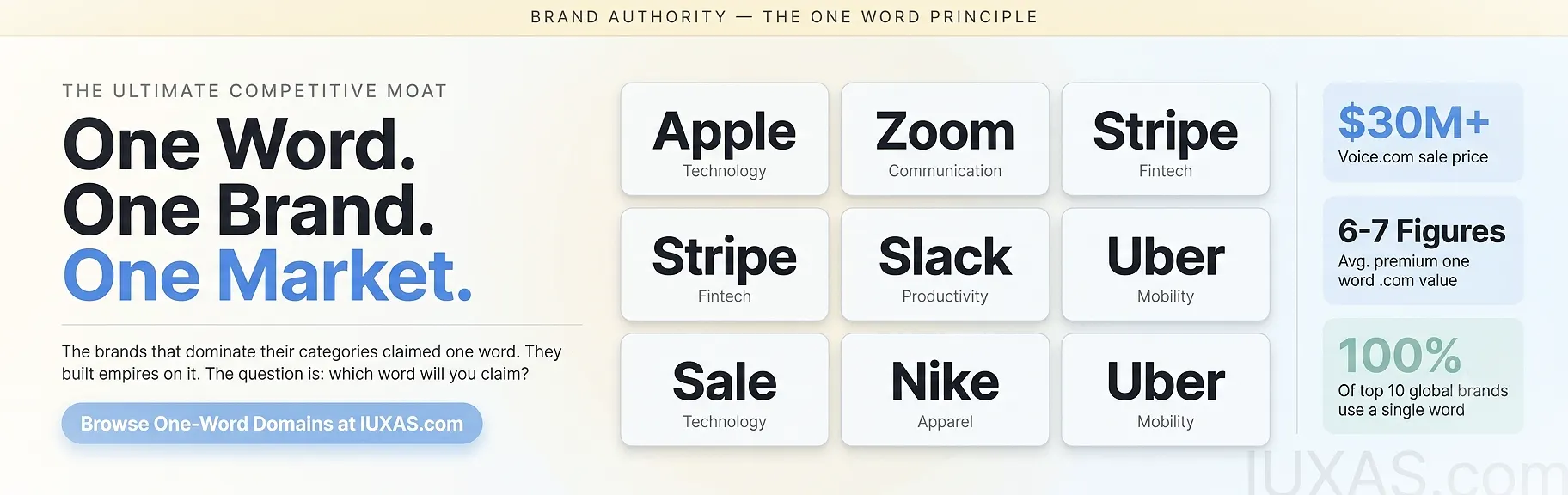
Now the question is: which word will you claim?
Ready to secure your competitive position in the digital market? Browse premium one-word domain names for sale at IUXAS and acquire the single-word asset that positions your brand as a category leader from day one.
Pingback: One-Word Domain for Investment Firm: A Balance-Sheet Asset
Pingback: Domain Name Pivot Rebrand Strategy for Startups