
Knowing how to value a one word domain means scoring it across brandability, search demand, length, TLD, domain history, industry fit, and comparable sales data. Professionals combine these seven factors into a single defensible number instead of guessing at a price. This framework removes the emotion from domain valuation and replaces it with a repeatable process.
Domain investors, brand consultants, and in-house marketing teams rarely agree on a single “correct” price for a premium domain. That disagreement usually comes down to methodology, not opinion. Once you understand how to value a one word domain the way an appraiser would, the guesswork disappears and pricing conversations become far more productive.
For buyers actively comparing one-word domain names for sale, this framework doubles as a due-diligence checklist before you commit budget to an acquisition.
If you’re still unsure what separates a true single-word asset from a multi-word variation, it helps to first understand what exactly makes a domain one word and why it matters before applying any valuation model.
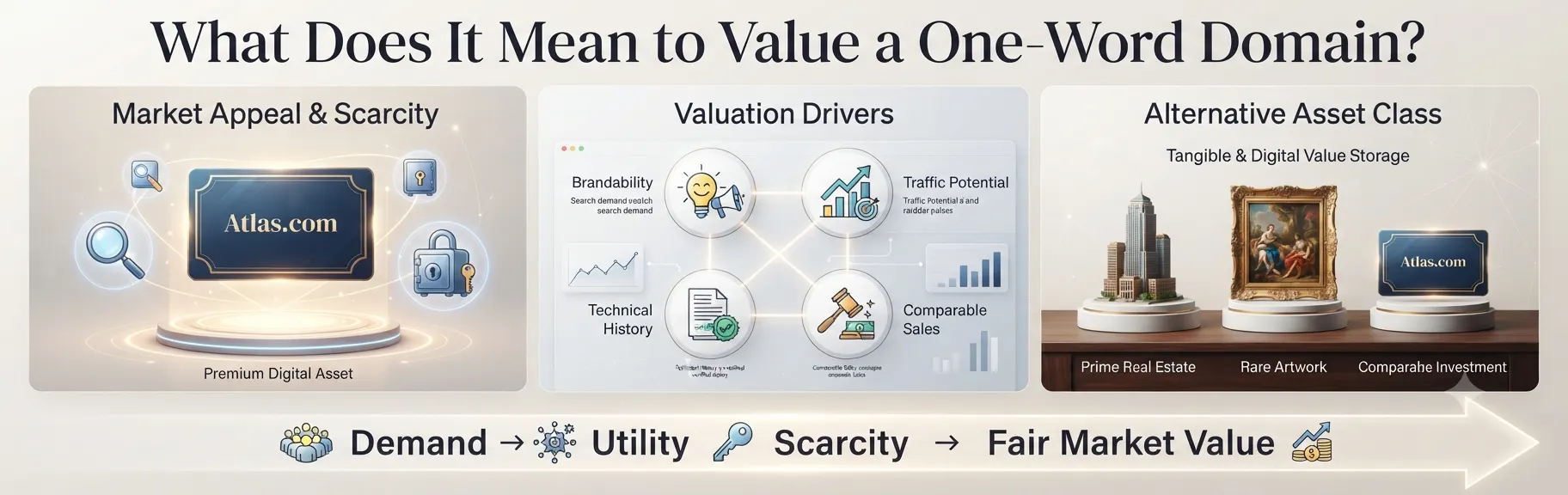
What Does It Mean to “Value” a One-Word Domain?
Valuing a domain simply means estimating what a rational buyer would pay for it in the current market. Unlike physical assets, domains don’t have a cost basis tied to materials or labor, so their worth is derived entirely from demand, utility, and scarcity.
A quick working definition:
Domain valuation is the process of estimating a domain’s fair market price by analyzing brandability, traffic potential, technical history, and recent comparable sales.
Because one-word .com domains are a finite resource, their pricing behaves more like real estate or intellectual property than like typical digital inventory.
Intrinsic Value vs. Market Value
A one-word domain can have two very different values:
Intrinsic Value
The theoretical value based on factors such as:
- Memorability
- Scarcity
- Commercial applications
- Branding potential
Market Value
The amount an actual buyer is willing to pay at a specific moment.
For example, a premium domain may be intrinsically worth six figures but remain unsold until the right buyer emerges.
Domains Behave Like Illiquid Assets
Unlike stocks, domains cannot always be sold instantly.
Their value depends on:
- Buyer demand
- Industry trends
- Economic conditions
- Timing
This is why domain pricing often involves wide valuation ranges rather than precise figures.
Replacement Cost Matters
Another useful question:
How difficult would it be to replace this domain with an equally strong alternative?
If the answer is “almost impossible,” the domain usually carries a premium.
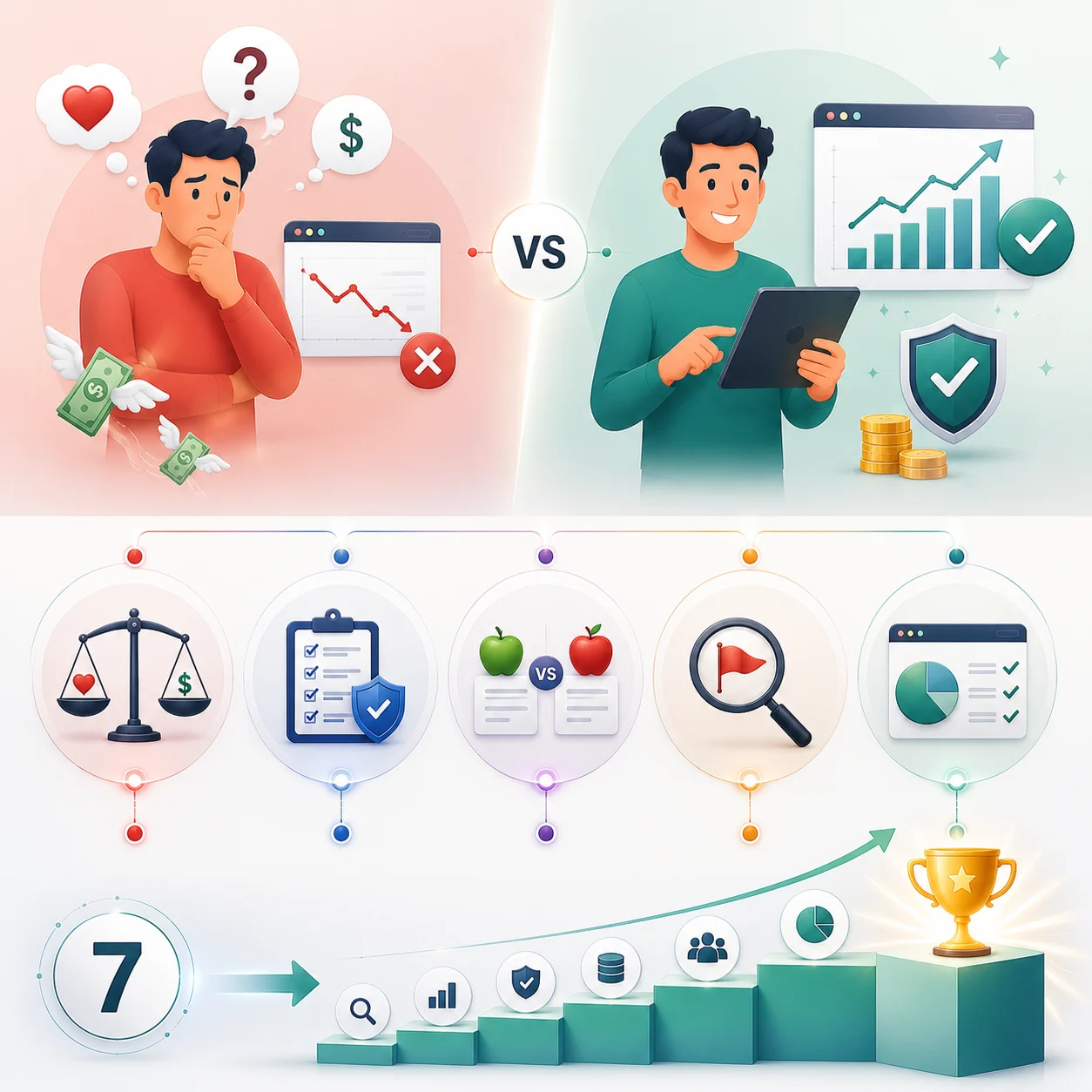
Why a Structured Framework Matters More Than Gut Instinct
Many first-time buyers price domains based on how the word “feels.” Consequently, they either overpay for a name with no commercial traction or walk away from a genuinely undervalued asset. A structured framework corrects both errors.
Here’s why professionals insist on a repeatable process:
- It removes emotional bias from six and seven-figure decisions.
- It creates a paper trail that justifies the price to stakeholders or investors.
- It allows apples-to-apples comparisons across an entire portfolio.
- It surfaces red flags, such as trademark conflicts, before money changes hands.
With that foundation in place, here is the 7-factor model itself.
Consistency Across Acquisitions
Large organizations often purchase multiple domains every year.
A framework allows:
- Consistent decision-making
- Easier budget approvals
- Portfolio comparisons
- Better investment tracking
Better Negotiation Leverage
A documented valuation framework gives buyers and sellers objective talking points during negotiations.
Instead of saying:
“I think it’s worth $20,000.”
You can explain:
“Comparable sales, search demand, and brandability indicate a range of $18,000–$25,000.”
The 7-Factor Framework to Value a One-Word Domain
Each factor below is scored independently, then weighted according to the buyer’s use case, whether that’s a startup brand, an SEO play, or a long-term investment hold.
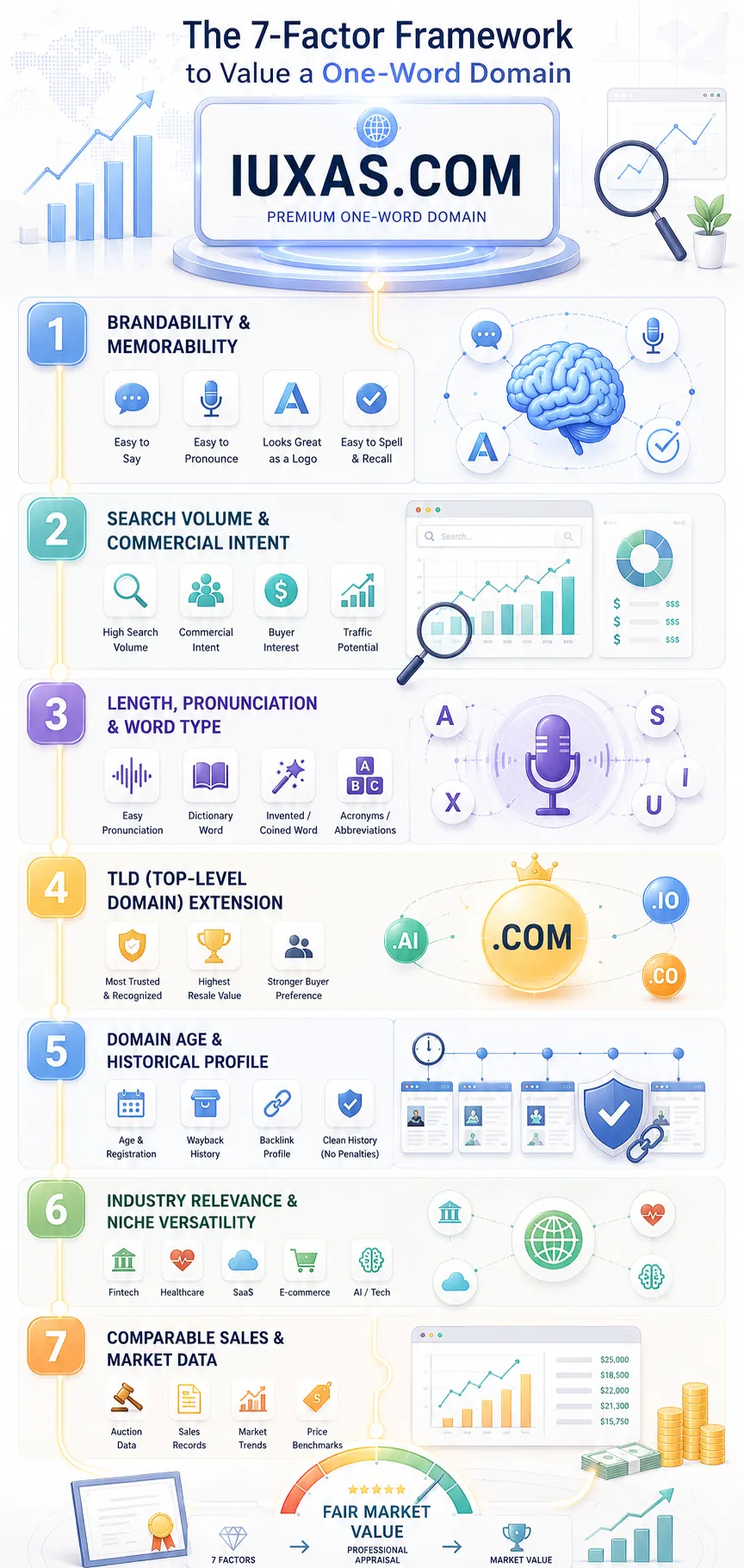
Factor 1: Brandability and Memorability
Brandability is often the single largest driver of price for a one-word domain. A name that’s easy to say, spell, and recall out loud carries more weight than one that merely ranks well in search.
Ask these questions when scoring brandability:
- Can someone spell it correctly after hearing it once?
- Does it work as a logo, app icon, or verbal pitch?
- Is it free of awkward letter combinations or ambiguous pronunciation?
Invented or coined words (think Google, Zapier) often score higher on distinctiveness, while dictionary words score higher on instant comprehension.
Factor 2: Search Volume and Commercial Intent
Search demand indicates how much organic traffic a domain could theoretically capture if built into a live site. However, raw volume alone is misleading unless it’s paired with commercial intent.
A domain tied to a high-volume keyword with genuine buying intent, rather than purely informational searches, typically commands a premium. Tools like Google Keyword Planner or Ahrefs are the standard starting point for this analysis.
Factor 3: Length, Pronunciation, and Word Type
Shorter is not automatically better; pronounceability matters just as much. A five-letter word that rolls off the tongue frequently outvalues a three-letter acronym that means nothing on its own.
Word type also affects value:
- Dictionary words – instantly understood, broad appeal, but harder to trademark exclusively.
- Coined or invented words – highly brandable and easier to protect legally.
- Acronyms or abbreviations – valuable mainly if tied to a recognized industry term.
Letter Quality Matters
- Not all letters have equal branding appeal.
- Premium letters often include:
- A, E, O, L, M, N, R, S, T.
- Less desirable combinations can be harder to brand and remember.
Typing Simplicity Adds Value
Domains that are:
- Easy to spell
- Easy to pronounce
- Difficult to mistype
generally appeal to a wider buyer pool.
International Pronunciation
A domain that can be pronounced across multiple languages often carries additional value due to its global branding potential.
Factor 4: TLD (Top-Level Domain) Extension
The extension can swing valuation dramatically. A .com extension still commands the strongest resale value and buyer trust worldwide, largely because of user habit and default browser behavior.
That said, alternative extensions such as .io, .ai, or .co have carved out legitimate niches, particularly in tech and startup circles, and shouldn’t be dismissed outright during appraisal.
Extension Trends Change Over Time
Certain industries have embraced alternative extensions.
Examples:
| Industry | Popular Extension |
|---|---|
| AI | .ai |
| Technology | .io |
| Startups | .co |
| Web3 | .xyz |
Understanding industry trends helps produce more accurate valuations.
Defensive Registration Considerations
Companies frequently purchase multiple extensions to:
- Protect their brand
- Prevent impersonation
- Reduce customer confusion
This can indirectly increase the value of premium domains.
Geographic Considerations
Certain country-code extensions perform exceptionally well within their local markets.
Examples:
- .de in Germany
- .ca in Canada
- .uk in the United Kingdom
Factor 5: Domain Age and Historical Backlink Profile
Older domains that have been continuously registered often carry residual trust signals with search engines. Appraisers typically check:
- Registration date and continuous ownership history
- Wayback Machine snapshots for prior legitimate use
- Backlink profile quality via Ahrefs or Moz, screened for spam
- Any history of penalties, blacklisting, or policy violations
A clean historical record adds measurable value; a spammy past can suppress it even if the word itself is excellent.
Historical Reputation Matters
A domain may have:
- Search engine penalties
- Spam history
- Malware reports
- Blacklisting incidents
These issues can significantly reduce value.
Existing Authority Can Be an Asset
Some aged domains possess:
- Media mentions
- Educational backlinks
- Industry citations
A clean authority profile can substantially increase commercial appeal.
Ownership Stability
Domains that have changed ownership repeatedly may sometimes indicate:
- Speculative trading
- Pricing uncertainty
- Previous monetization failures
Stable ownership histories can be viewed more favorably.
Factor 6: Industry Relevance and Niche Versatility
Some one-word domains are hyper-specific to a single vertical, while others flex across multiple industries. Versatility widens the buyer pool, which generally pushes price upward through competitive demand.
Before finalizing this score, check whether the word carries unwanted connotations in other markets or languages, since a name that works well in English can misfire elsewhere.
Category-Defining Words Command Premiums
Certain words essentially define entire industries.
Examples:
- Finance
- Travel
- Energy
- Fitness
Category-defining terms often attract multiple buyers simultaneously.
Future Industry Expansion
Consider whether the industry itself is expected to grow.
Emerging sectors such as:
- Artificial Intelligence
- Robotics
- Climate Technology
- Biotechnology
can increase demand for relevant domains.
Cross-Industry Appeal
Some domains have applications in multiple industries.
Examples:
- Summit
- Radius
- Origin
- Pulse
Versatility often increases competition among buyers.
Factor 7: Comparable Sales and Market Data
Finally, professionals anchor their estimate against real transaction data rather than theoretical value alone. Marketplaces and aftermarket sales records (NameBio, Sedo, GoDaddy Auctions) provide a benchmark of what similar one-word assets actually sold for recently.
This step transforms the first six factors from an abstract score into a defensible dollar figure grounded in actual market behavior.
Recent Sales Matter More Than Historic Sales
Domain markets evolve.
A sale from ten years ago may have little relevance today.
Professionals generally prioritize:
- Recent transactions
- Similar industries
- Similar lengths
- Similar extensions
Market Sentiment Influences Pricing
Domain values can rise or fall due to:
- Economic conditions
- Startup funding trends
- Technology cycles
- Investor demand
Comparable sales should always be interpreted within current market conditions.
Avoid Cherry-Picking Comps
Selecting only the highest comparable sales often leads to unrealistic expectations.
Use:
- Median values
- Average values
- Price ranges
for a more balanced valuation.
Quick-Reference Table: The 7 Factors at a Glance
| Factor | What It Measures | Why It Matters |
|---|---|---|
| Brandability | Memorability, spelling ease | Drives long-term brand equity |
| Search Volume | Organic demand and intent | Indicates traffic potential |
| Length & Word Type | Pronunciation, structure | Affects usability across platforms |
| TLD Extension | .com vs alternatives | Impacts buyer trust and resale value |
| Domain Age & History | Backlinks, past use | Signals SEO trust or risk |
| Industry Relevance | Niche vs cross-industry fit | Widens or narrows the buyer pool |
| Comparable Sales | Real transaction data | Anchors price to the actual market |
Comparison: DIY Valuation vs. Professional Valuation
| Aspect | DIY / Free Tools | Professional Appraisal |
|---|---|---|
| Data sources | Automated estimators only | Comps, backlink audits, trademark checks |
| Accuracy for premium names | Often inconsistent | Grounded in verified sales data |
| Trademark & legal screening | Rarely included | Standard practice |
| Best suited for | Low-value, casual domains | Six and seven-figure one-word assets |
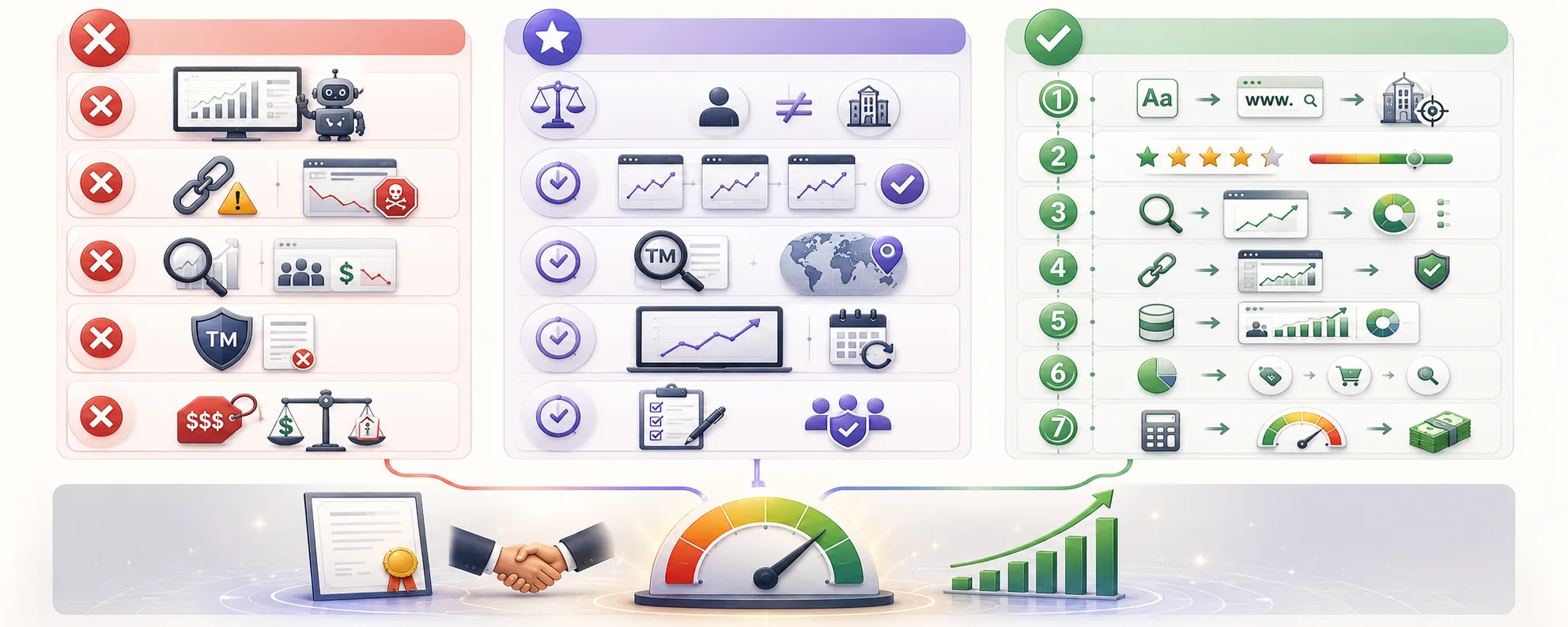
Common Mistakes Buyers and Sellers Make
Even experienced buyers fall into predictable traps when they skip a structured process:
- Relying only on automated appraisal tools. Algorithms rarely account for brandability or cultural nuance.
- Ignoring backlink history. A cheap domain with a toxic backlink profile can cost more in SEO recovery than it saved upfront.
- Overweighting search volume alone. High traffic without commercial intent rarely converts to revenue.
- Skipping trademark checks. A perfect brand name is worthless if it triggers a legal dispute.
- Anchoring to asking price instead of comps. Sellers often list aspirationally; real value sits closer to recent comparable sales.
Assuming Automated Appraisals Are Accurate
Automated tools struggle to measure:
- Brandability
- Emotional appeal
- Market timing
- Buyer motivation
They should be used only as reference points.
Ignoring Liquidity
A domain can be highly valuable yet difficult to sell quickly.
Value and liquidity are not the same thing.
Overestimating Personal Attachment
Owners frequently overvalue domains because of:
- Time spent holding them
- Emotional attachment
- Original purchase price
Markets rarely reward sentiment.
Expert Tips for a More Accurate Valuation
- Weight the factors according to your actual use case; an investor and a startup founder should not use identical weightings.
- Always cross-reference at least three recent comparable sales before finalizing an offer.
- Run a trademark search in your target market before negotiating price.
- Reassess valuation periodically since search trends and TLD trust shift over time.
- Document your scoring rationale so the decision can be defended to stakeholders later.
Create a Weighted Scoring Model
Example:
| Factor | Weight |
|---|---|
| Brandability | 30% |
| Search Demand | 20% |
| TLD | 15% |
| History | 10% |
| Industry Fit | 15% |
| Comparable Sales | 10% |
Different buyers can adjust these percentages based on their objectives.
Review Valuations Annually
Domain values can change because of:
- Industry growth
- New technologies
- Shifts in consumer behavior
- Changing search trends
Periodic reviews help maintain accurate portfolio valuations.
Document Every Assumption
Recording why you assigned a score improves:
- Future decision-making
- Team collaboration
- Investment transparency
Step-by-Step: How to Apply This Framework Yourself
- List the domain’s core attributes – length, word type, TLD, and industry alignment.
- Score each of the 7 factors on a simple 1-10 scale.
- Pull search volume and intent data from a keyword research tool.
- Audit backlink and registration history using an SEO auditing platform.
- Gather 3-5 comparable sales from a domain aftermarket database.
- Weight the factors based on your intended use (brand build, resale, or SEO).
- Calculate a price range, not a single number, to leave room for negotiation.
Create a Scoring Spreadsheet
Track:
- Factor scores
- Comparable sales
- Notes
- Market observations
This makes valuations more consistent.
Revisit the Valuation Before Making an Offer
A second review often uncovers:
- Overlooked legal risks
- Better comparables
- Industry changes
- Improved negotiation opportunities
Frequently Asked Questions
How do you value a one word domain accurately? You value a one word domain by scoring brandability, search demand, length and pronunciation, TLD, domain history, industry relevance, and comparable sales, then weighting those factors against your intended use.
What makes a one-word domain more valuable than a multi-word domain? Scarcity and brandability. There are far fewer available one-word combinations, and short, memorable names generally perform better as standalone brands.
Does the TLD extension really affect a one-word domain’s price? Yes. A .com extension typically retains the highest resale value and buyer trust, though .io and .ai have gained legitimate traction in tech-focused niches.
Is a dictionary word always worth more than an invented word? Not necessarily. Dictionary words offer instant recognition, while invented words often provide stronger trademark protection and brand distinctiveness. The better choice depends on the buyer’s goals.
How many comparable sales should I check before buying? Most professionals reference at least three to five recent comparable sales from a reputable aftermarket database before finalizing a price.
Why are some one-word domains worth millions?
Because they combine:
- Extreme scarcity
- Strong brandability
- Broad commercial applications
- High buyer demand.
Can a one-word domain lose value?
Yes. Industry changes, declining trends, and reputational issues can reduce demand and valuation.
Are all dictionary words valuable?
No. Some words have limited commercial appeal or very small buyer pools.
Should startups pay premium prices for one-word domains?
It depends on:
- Available funding
- Branding strategy
- Long-term vision
- Competitive landscape.
For some companies, the right domain can become a strategic asset that delivers value for decades.
Final Thoughts
Learning how to value a one word domain is less about intuition and more about applying a consistent, defensible process. Brandability, demand, technical history, and real market comps all play a role, and no single factor should override the rest.
Whether you’re acquiring your first premium name or expanding a domain portfolio, this same 7-factor approach protects you from overpaying and helps you negotiate from a position of knowledge.
Think in Terms of Probability, Not Precision
Professional appraisers rarely produce one exact number. Instead, they estimate a realistic range based on evidence and market conditions.
The purpose of valuation is not to predict the future perfectly but to make informed decisions using:
- Data
- Comparable transactions
- Commercial demand
- Strategic context
A disciplined framework transforms domain valuation from guesswork into a repeatable and defensible process that can be applied across acquisitions, portfolio management, and negotiations.
Pingback: Startup Naming Strategy: Why One-Word Names Win
Pingback: One-Word Domain for Investment Firm: A Balance-Sheet Asset
Pingback: Domain Name Pivot Rebrand Strategy for Startups
Pingback: One Word Domain Category Performance: Top Sectors