
Learning how to buy a one word domain requires a structured acquisition workflow: identifying the asset, verifying its ownership status, securing an accurate valuation, and closing the transfer through a licensed escrow provider. This process typically spans initial discovery, direct or brokered negotiation, secure payment, and registrar-level transfer of the EPP authorization code. Unlike registering a fresh domain, acquiring a premium one-word name almost always means negotiating with an existing owner rather than a registry.
Buying a domain built entirely around a single dictionary word or invented brand term is fundamentally different from registering an available name off the shelf. Most one-word .com domains were claimed decades ago, which means the modern buyer is really stepping into a secondary market of resale, negotiation, and verified one-word domain names for sale rather than a simple checkout process. That shift changes everything: pricing, legal safeguards, and the technical steps needed to move a name from a seller’s account into yours.
This guide walks through the entire acquisition journey in order, so you can move from your first search to holding full registrar-level control of the domain, without missing a step that could expose you to fraud or a failed transfer.
Quick Answer: What Buying a One-Word Domain Actually Involves
If you only have a minute, here is the condensed version of how to buy a one word domain:
- Define your naming criteria and budget before searching.
- Search marketplaces, brokers, and expired-domain listings.
- Confirm current ownership and registration status via WHOIS.
- Get an independent valuation before making an offer.
- Contact the owner or use a broker to open negotiations.
- Agree on price and payment terms in writing.
- Use a licensed escrow service to hold funds securely.
- Complete the registrar transfer using the EPP/auth code.
- Verify DNS, ownership records, and renewal settings post-transfer.
Each of these stages carries its own risks and best practices, which the sections below break down in detail.
Why One-Word Domains Command a Different Buying Process
A one-word domain is not simply short. It’s a name built from a single, standalone lexical unit rather than a combination of words, prefixes, or modifiers – a distinction covered in more depth in our guide on what exactly makes a domain one word. That structural simplicity is precisely what makes these names valuable: they’re easier to remember, easier to pronounce across languages, and harder for competitors to replicate.
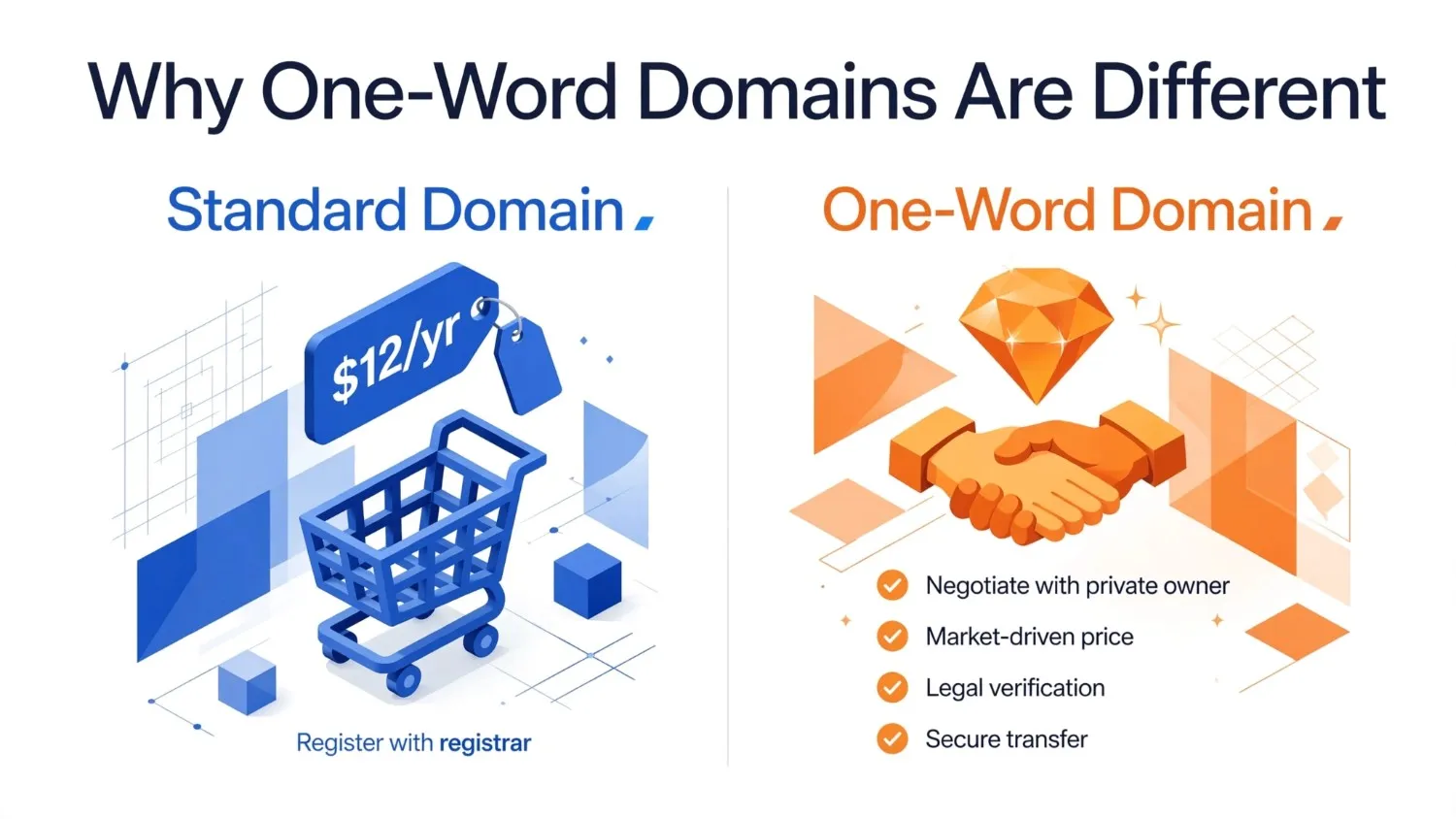
Because almost all short, dictionary-word .com domains were registered years ago, buying one typically means:
- Negotiating with a private owner or investor, not a registrar.
- Paying a market-driven price rather than a flat registration fee.
- Verifying legal standing (trademarks, prior disputes, encumbrances).
- Using secure transfer mechanisms built for high-value assets.
Understanding this distinction early prevents a common beginner mistake: assuming a one-word domain purchase works like registering a new website name for $12 a year.
Step 1: Define Your Naming Criteria Before You Search
Before opening a single marketplace tab, clarify what the domain needs to accomplish for your brand. Buyers who skip this step often overspend on a name that doesn’t actually fit their positioning.
Ask yourself:
- Does the word need to be literal (describing the product) or abstract (evocative, brandable)?
- Is a .com extension mandatory, or are .io, .co, or .ai acceptable?
- What’s the maximum budget, including buyer’s premium or broker fees?
- Will the name need to work internationally, across multiple languages?

Setting these boundaries early narrows your search dramatically and keeps negotiations focused.
Step 2: Search Marketplaces, Brokers, and Aftermarket Listings
Once your criteria are set, the search itself typically spans three channels:
- Curated marketplaces that list vetted, ready-to-transfer one-word domains, often with pricing already visible.
- Domain brokers, who can approach an owner privately on your behalf when a name isn’t publicly listed.
- Expired or auction listings, where domains occasionally re-enter the market after non-renewal.
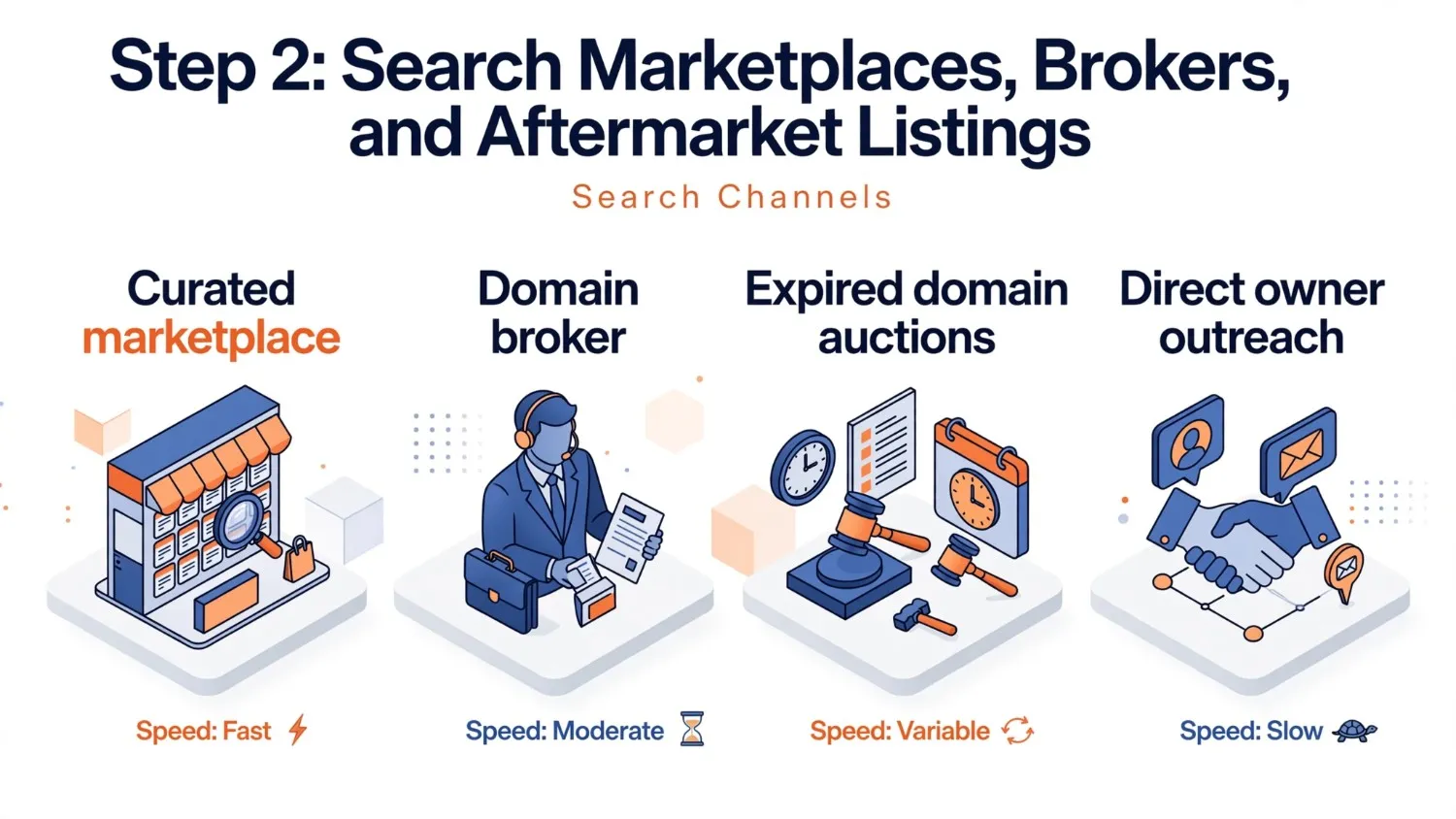
Marketplaces built specifically around single-word inventory tend to be faster than cold outreach, since ownership, pricing expectations, and transfer logistics are usually already established. This is also where most buyers first encounter one-word domain names for sale that are pre-verified for clean ownership history.
Featured Snippet Box: Where to Look First
| Channel | Best For | Typical Speed |
|---|---|---|
| Curated marketplace | Verified inventory, transparent pricing | Fast (days) |
| Domain broker | Off-market or unlisted names | Moderate (weeks) |
| Expired domain auctions | Budget-conscious buyers | Variable |
| Direct owner outreach | Highly specific target names | Slow (weeks to months) |
Step 3: Confirm Ownership and Registration Status
Before you contact anyone or make an offer, verify the domain’s current status. Skipping this step is one of the most common mistakes new buyers make.
Check the following:
- WHOIS/RDAP records to confirm the registered owner, registrar, and expiration date.
- Registration lock status – a locked domain cannot be transferred until unlocked by the current owner.
- Trademark conflicts, particularly if the word overlaps with an existing registered brand in your industry.
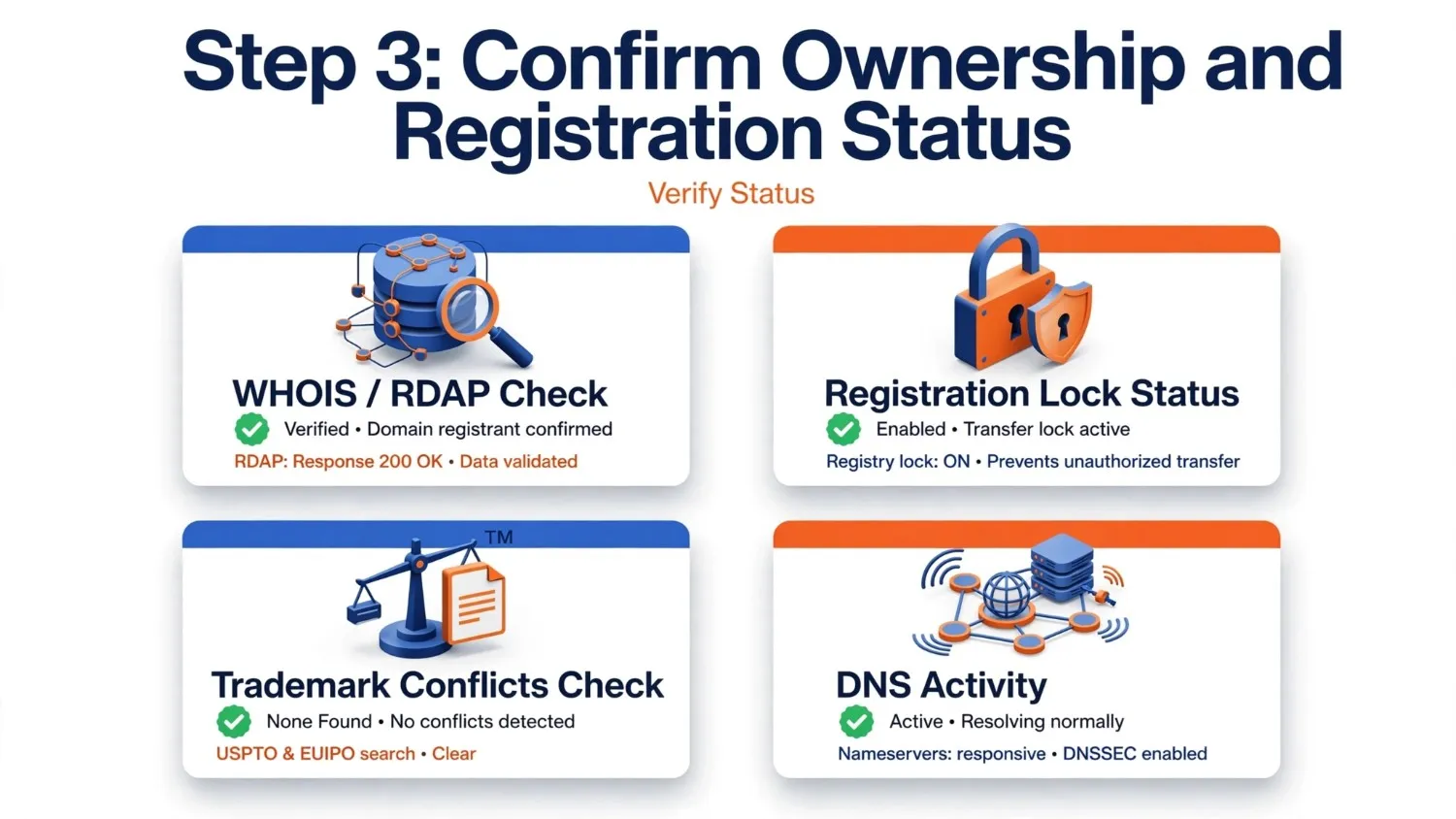
- DNS activity – an actively used domain may involve a live business, which can affect price and urgency.
Public trademark records can be checked directly through official government databases such as the USPTO’s Trademark Electronic Search System, which helps confirm whether the exact word is already protected in your category.
Why Ownership Verification Matters More Than Buyers Expect
Many first-time buyers treat this step as a formality and move straight to negotiation. That’s a mistake, because the WHOIS or RDAP record tells you far more than just “who owns it.”
- Registrar identity determines which transfer rules apply, since some registrars impose additional verification steps beyond the standard ICANN process.
- Creation date gives you a sense of how long the current owner has held the domain, which can hint at their pricing expectations – long-held names are often priced higher due to sentimental or strategic value.
- Recent ownership changes matter too. If a domain changed hands within the last 60 days, most registries impose a transfer lock, meaning you may need to wait before a new transfer can even be initiated.
- Privacy-protected records aren’t a red flag on their own, but they do mean you’ll need to go through a marketplace contact form or broker rather than emailing the owner directly.
Skipping this diligence step is one of the fastest ways to waste weeks of negotiation on a domain that legally cannot move yet, or that carries a dispute history you didn’t know about.
Step 4: Get an Independent Valuation Before You Offer
Pricing one-word domains is notoriously inconsistent, since sellers often anchor on aspirational figures rather than market comparables. Before negotiating, run the name through a structured valuation process rather than accepting the listed price at face value.
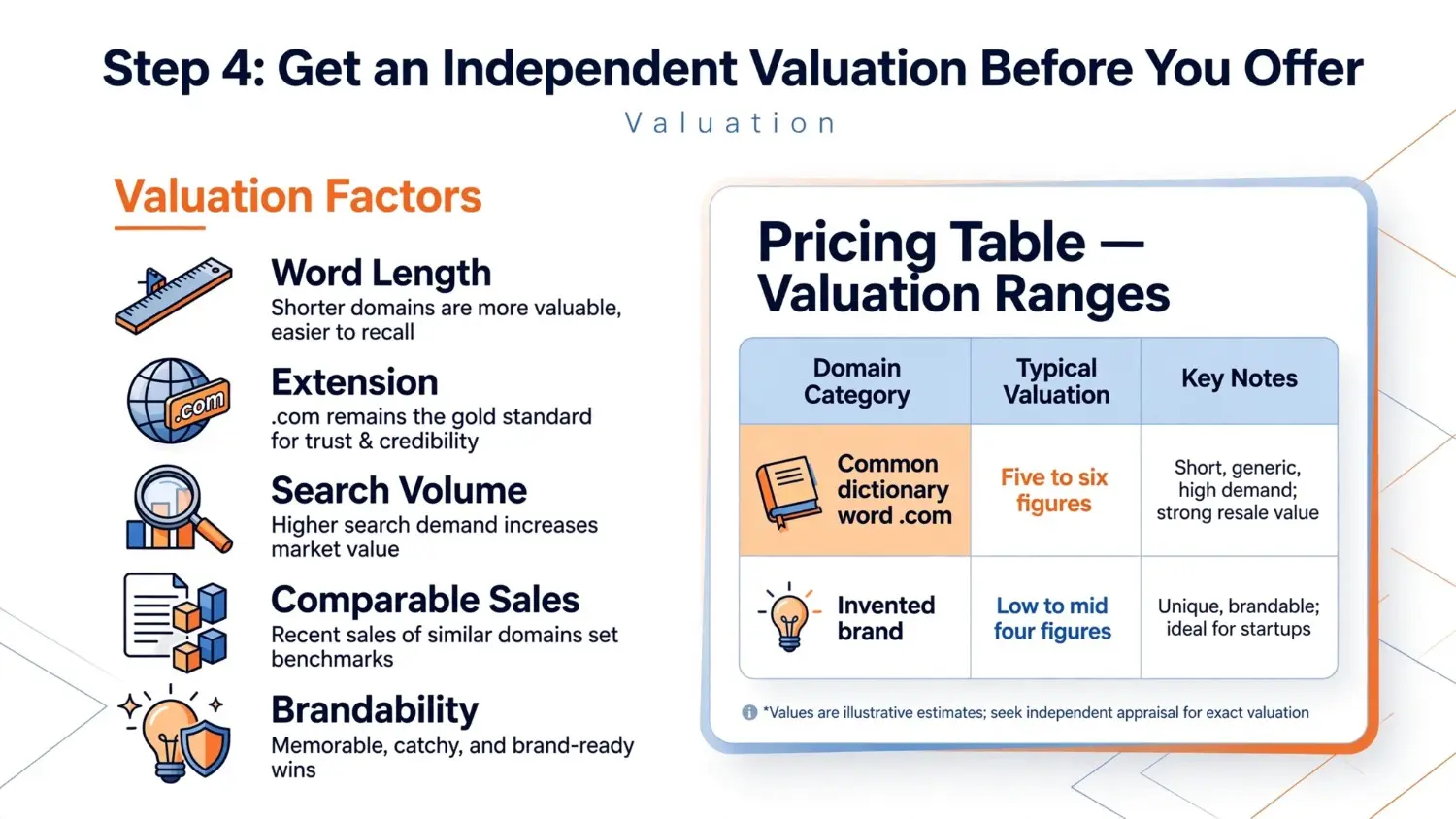
Our detailed breakdown on how to value a one-word domain covers the core variables that matter most:
- Word length, pronounceability, and memorability.
- Extension (.com generally commands the highest multiple).
- Search volume and existing commercial intent tied to the word.
- Comparable sales of similarly structured domains.
- Brandability across industries versus niche-specific appeal.
A grounded valuation gives you a defensible starting offer and protects you from overpaying during a negotiation that can otherwise become emotionally driven.
How Pricing Typically Breaks Down by Category
While every one-word domain is priced individually, buyers benefit from understanding rough market bands before entering a negotiation. These figures are illustrative, not fixed, since actual pricing depends heavily on industry fit and buyer demand at the time of sale.
| Domain Type | Typical Market Range | Key Value Driver |
|---|---|---|
| Common dictionary word (.com) | Five to six figures | Search volume, brandability |
| Invented/coined one-word brand | Low to mid four figures | Uniqueness, pronounceability |
| Common word (.io/.co/.ai) | Low to mid four figures | Startup and tech relevance |
| Industry-specific term (.com) | Mid four to low five figures | Niche commercial intent |
Treat this table as a starting orientation rather than a pricing guarantee. The only reliable way to price a specific name is to run it through a structured framework and compare it against recent, verifiable sales of similarly structured domains.
Red Flags in Seller-Provided Valuations
Sellers sometimes reference third-party “appraisal tools” to justify an asking price. Be cautious here, since many automated appraisal tools rely on simplistic algorithms that overweight domain length and underweight actual commercial demand. Treat automated appraisals as a loose reference point only, and always cross-check against real transaction data before finalizing your offer.
Step 5: Open Negotiations – Directly or Through a Broker
With a target price range established, it’s time to make contact. Two paths are common here:
Direct outreach works well when the seller is responsive and the domain is already market-facing, meaning contact details are visible via a “domain for sale” landing page or listed broker.
Broker-assisted negotiation is generally more effective for high-value or unlisted names, since brokers can approach sellers without revealing the buyer’s identity, which often prevents inflated “brand premium” pricing.

Expert tip: keep your first message short, professional, and free of urgency signals. Sellers who sense desperation frequently raise their asking price mid-negotiation.
Structuring Your Opening Offer
A well-structured first offer does more than state a number – it signals that you’ve done your homework, which tends to produce more serious counteroffers. Consider including:
- A brief statement of intended use (without revealing your full brand strategy).
- Your valuation range, framed as market-based rather than arbitrary.
- A proposed timeline for completing the deal.
- A note that you’re prepared to use a licensed escrow service, which reassures sellers who have been burned by non-serious buyers before.
Handling Counteroffers Without Overpaying
Negotiations on premium one-word domains often involve two or three rounds of back-and-forth. A few practical guardrails help keep this process rational:
- Set your maximum price privately before negotiations begin, and don’t reveal it.
- Respond to counteroffers with reasoning (“comparable .com sales in this range were X”), not just a lower number.
- If a seller won’t move and your valuation supports a lower price, be willing to walk away – inventory in the one-word space refreshes regularly, and no single domain is irreplaceable.
- Avoid negotiating over multiple channels simultaneously (e.g., email and a marketplace chat at once), since it can create conflicting commitments.
Step 6: Agree on Price and Terms in Writing
Once a number is agreed upon, formalize the terms before any money moves. A basic purchase agreement should cover:
- Final agreed price and currency.
- Payment method and timeline.
- Which party pays escrow or broker fees.
- Transfer deadline and responsibilities of each party.
- What happens if the transfer fails or is delayed.
Even a short written agreement, exchanged by email, is far safer than a verbal handshake deal, particularly for four- and five-figure transactions.

Step 7: Use a Licensed Escrow Service
This is the single most important safeguard in the entire process. Never wire funds directly to a domain seller you don’t already have a verified business relationship with.
A licensed escrow service works like this:
- Buyer deposits funds with the escrow provider.
- Escrow confirms funds have cleared.
- Seller initiates the domain transfer to the buyer.
- Buyer confirms receipt and control of the domain.
- Escrow releases funds to the seller.

This sequence protects both sides: the seller isn’t asked to transfer first without payment assurance, and the buyer isn’t asked to pay before receiving the asset. For general guidance on secure online transaction practices, the Federal Trade Commission’s consumer protection resources outline red flags common to online payment fraud that apply directly to private domain sales.
Choosing an Escrow Provider
Not all escrow services are built the same way, and domain transactions have specific requirements that generic payment platforms don’t handle well. When evaluating a provider, check for:
- Domain-specific escrow experience, since the provider should understand EPP codes, registrar locks, and transfer timelines rather than treating a domain like a generic digital good.
- Licensing and regulatory standing in the jurisdiction where the service operates.
- Fee transparency – escrow fees are typically a small percentage of the transaction value, and should be disclosed upfront rather than added as a surprise at closing.
- Dispute resolution process in case the transfer stalls or the domain doesn’t match what was agreed upon.
What Happens If a Transfer Fails Mid-Escrow
Occasionally a transfer stalls due to a registrar lock, an outdated auth code, or a seller who becomes unresponsive. A properly structured escrow arrangement accounts for this in advance by defining:
- A maximum window (commonly 5-10 business days) for the seller to complete the transfer.
- What happens to the funds if that window passes without a completed transfer.
- Whether partial fees (e.g., broker commission) are still owed if the deal falls through after work has already been done.
Having these terms defined before funds are deposited prevents a stalled transfer from turning into a prolonged dispute.
Step 8: Complete the Registrar Transfer
Once escrow confirms funds, the technical transfer begins. The exact steps vary slightly by registrar, but generally follow this pattern:
- Seller unlocks the domain at their current registrar.
- Seller generates and shares the EPP/authorization code.
- Buyer initiates a transfer request at their preferred registrar, entering the auth code.
- Seller approves the transfer request (via email or account confirmation).
- Transfer completes, typically within 5-7 days depending on the registry.
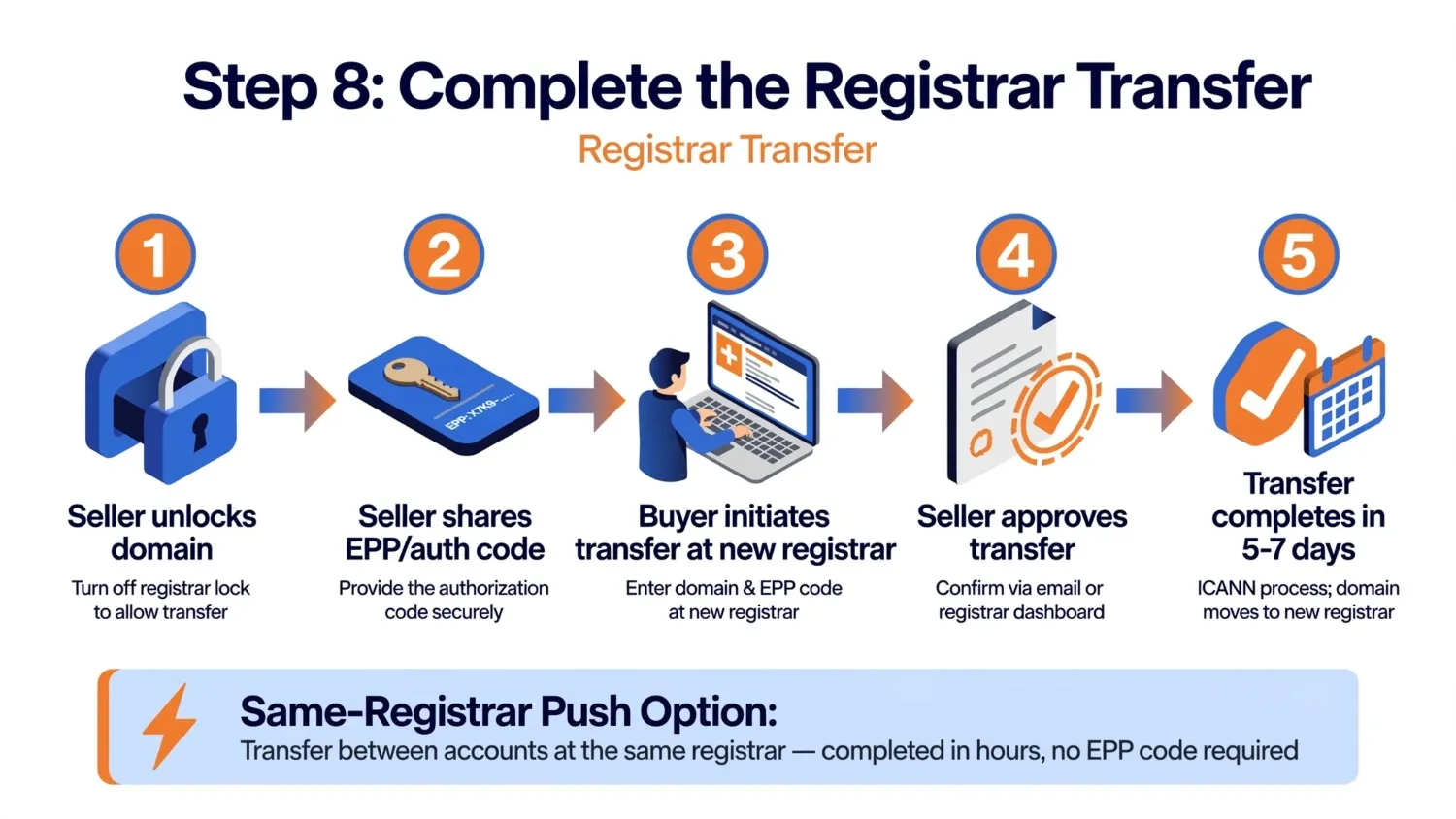
Some marketplaces offer an internal, same-registrar “push” transfer instead, which can complete within hours rather than days if both parties use the same registrar account system. ICANN’s official transfer policy documentation outlines the standard rules registrars must follow during this process, which is useful reference material if a transfer stalls unexpectedly.
Step 9: Verify Ownership, DNS, and Renewal Settings
After the transfer completes, don’t assume everything is automatically correct. Confirm:
- WHOIS/RDAP now lists you (or your organization) as the registrant.
- DNS records point to your intended hosting or website builder.
- Auto-renewal is enabled under your own payment method.
- Domain privacy protection is applied if desired.
- Two-factor authentication is enabled on your registrar account.

This final verification step closes the loop and ensures the asset is fully and securely under your control.
Common Mistakes to Avoid When Buying a One-Word Domain
- Paying before transfer confirmation. Always route payment through escrow, never directly.
- Skipping trademark checks. A cheap domain can become expensive litigation if it infringes an existing mark.
- Anchoring to the seller’s asking price. Independent valuation should always precede your offer.
- Ignoring registrar lock status. A locked domain cannot move until the seller unlocks it.
- Ignoring the transfer window. Some transfers are subject to a 60-day lock after a prior ownership change; confirm this before agreeing to timelines.
- Negotiating without a walk-away number. Buyers who enter a conversation without a firm ceiling often get anchored by the seller’s framing and end up paying more than the domain’s actual market value supports.
- Assuming all escrow providers are equivalent. Generic freelance-marketplace escrow tools are not built for domain-specific transfer mechanics, and using the wrong provider can slow down or complicate an otherwise straightforward deal.
- Forgetting to renew immediately after transfer. A domain that arrives close to its expiration date should be renewed right away under the new owner’s account to avoid an accidental lapse.
Expert Tips for a Smoother Acquisition
- Request a screenshot of the WHOIS record and registrar dashboard as informal proof of ownership before escrow begins.
- If negotiating directly, propose a private broker-mediated escrow rather than a generic freelance platform.
- For extensions beyond .com, confirm the registry’s specific transfer rules, since some ccTLDs (e.g., country-code domains) have additional local requirements.
- Budget an extra 5-10% above your target price for broker or escrow fees.
International and Multi-Extension Considerations
Buyers focused only on .com can miss valuable opportunities, but expanding into other extensions introduces a few extra considerations worth planning for in advance.
- Country-code domains (ccTLDs) such as those tied to a specific nation often require local presence requirements, meaning the buyer must have a registered business or residency in that country to hold the domain directly. A local proxy or nominee service is sometimes used to work around this, though it adds a layer of complexity to the transfer.
- New generic extensions (.io, .ai, .co, and similar) generally follow the standard ICANN transfer process, making them simpler to acquire than ccTLDs, but they can carry higher renewal fees that should be factored into your long-term budget.
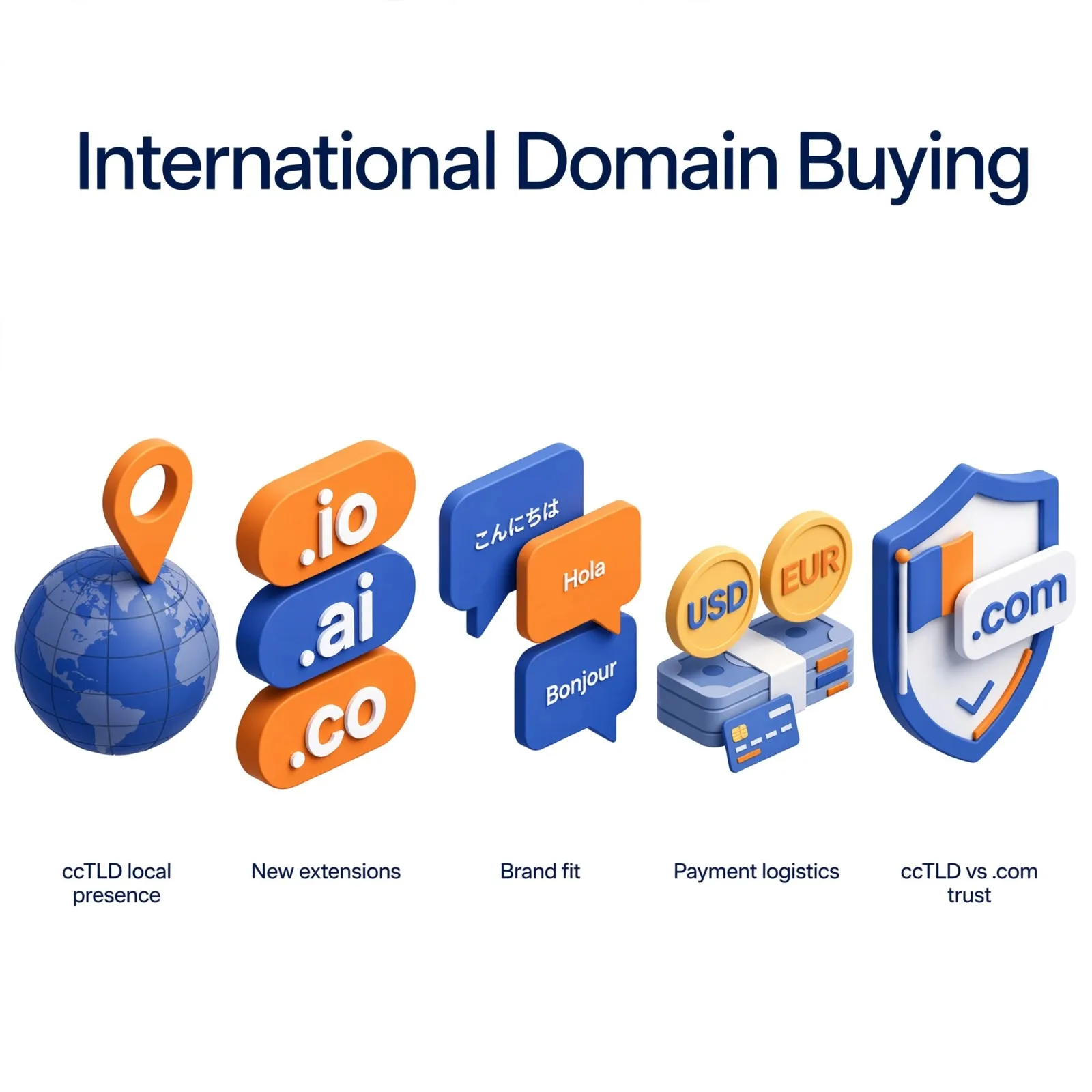
- Currency and payment logistics can complicate cross-border deals. Confirm early which currency the escrow transaction will be denominated in, and whether either party is responsible for wire transfer or currency conversion fees.
- Multi-language brand fit matters if you plan to expand internationally. A one-word domain that reads naturally in English may carry unintended meanings or pronunciation issues in other markets, so a quick linguistic check is worth the time before finalizing a purchase.
Buyers targeting a specific international market sometimes prioritize the local ccTLD over a .com equivalent, particularly in regions where local extensions carry stronger consumer trust. Weigh this against your primary audience before locking in your final target list.
Comparison Table: Buying Channels at a Glance
| Method | Typical Cost Premium | Speed | Best For |
|---|---|---|---|
| Curated marketplace | Moderate | Fast | Verified, ready-to-buy inventory |
| Domain broker | Higher (commission-based) | Moderate | Unlisted, high-value targets |
| Direct owner outreach | Variable | Slow | Specific, must-have names |
| Expired auction | Lower | Variable | Budget-conscious buyers |
Frequently Asked Questions
How long does it take to buy a one-word domain?
A marketplace purchase with escrow can close within days, while broker-negotiated deals for unlisted names often take several weeks depending on seller responsiveness.
Is it safe to pay a domain seller directly without escrow?
No. Direct payment without escrow removes the protection that confirms funds and ownership transfer happen in the correct sequence, exposing buyers to fraud risk.
What’s the difference between a domain transfer and a domain push?
A transfer moves a domain between different registrars using an auth code, while a push moves it between accounts on the same registrar, which is typically faster.
Do I need a broker to buy a one-word domain?
Not always. Marketplace-listed names can often be purchased directly, but a broker is valuable when a name isn’t publicly for sale or when anonymity benefits the negotiation.
Can trademark issues block a one-word domain purchase?
Yes. If the word is a registered trademark in your target industry, using it commercially afterward could trigger a legal dispute even if the domain purchase itself completes successfully.
What happens if the seller becomes unresponsive after I deposit funds in escrow?
A properly structured escrow agreement sets a defined response window, after which the buyer is typically entitled to a refund if the seller fails to complete the transfer within the agreed timeframe.
Should I buy a one-word domain if a close variation is already trademarked?
Proceed cautiously. Even a close variation can create legal exposure depending on the industry and jurisdiction, so it’s worth a brief trademark clearance check before committing to a purchase in that specific category.
Conclusion
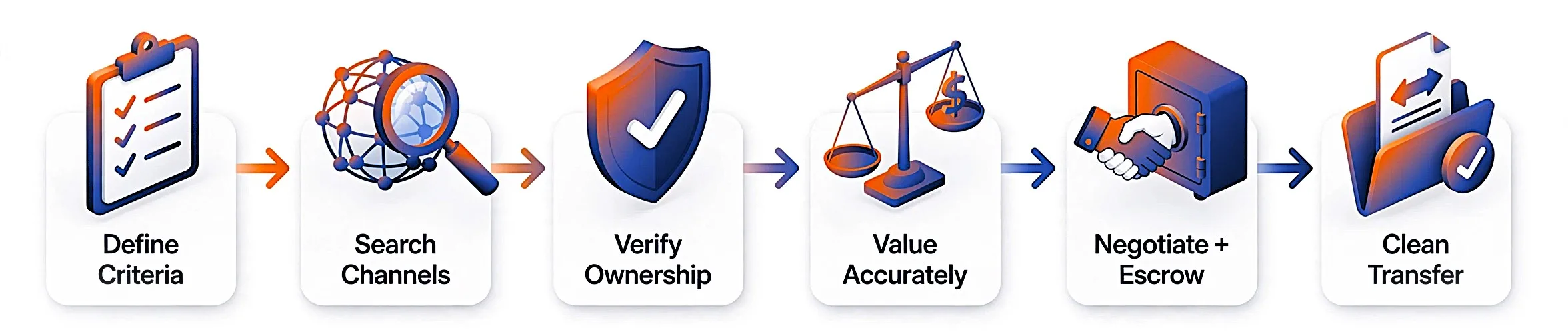
Acquiring a one-word domain is less about luck and more about following a disciplined sequence: defining criteria, searching the right channels, verifying ownership, valuing the asset accurately, negotiating carefully, and closing through escrow before completing a clean registrar transfer. Buyers who follow this order consistently avoid the fraud, overpayment, and legal exposure that derail rushed purchases.
If you’re ready to move from research to acquisition, and start your search with inventory that’s already vetted for clean ownership and transfer readiness.
Pingback: Domain Name Pivot Rebrand Strategy for Startups