
A domain name for global expansion is the single infrastructure decision that determines whether a brand scales as one unified entity or fragments into dozens of disconnected local sites. One-word .com domains centralize brand equity, backlink authority, and user trust under a single global address, while ccTLD portfolios (country-code top-level domains such as .de, .jp, or .in) signal local relevance and can satisfy regional legal or hosting requirements. Neither model is universally superior; the right choice depends on market count, budget, legal exposure, and how much SEO authority a brand is willing to split across multiple properties.
Choosing a domain name for global expansion is rarely as simple as registering whatever is available. Brands preparing to enter five, ten, or fifty new markets face a genuine architectural decision, not a cosmetic one. Get it wrong, and a company can spend years untangling redirects, diluted backlink profiles, and confused customers who cannot tell which regional site is authoritative. This is precisely the kind of strategic groundwork that a premium one-word domain portfolio is built to solve, since a single, short, brandable .com asset gives international teams one anchor to build around instead of a patchwork of regional guesses.
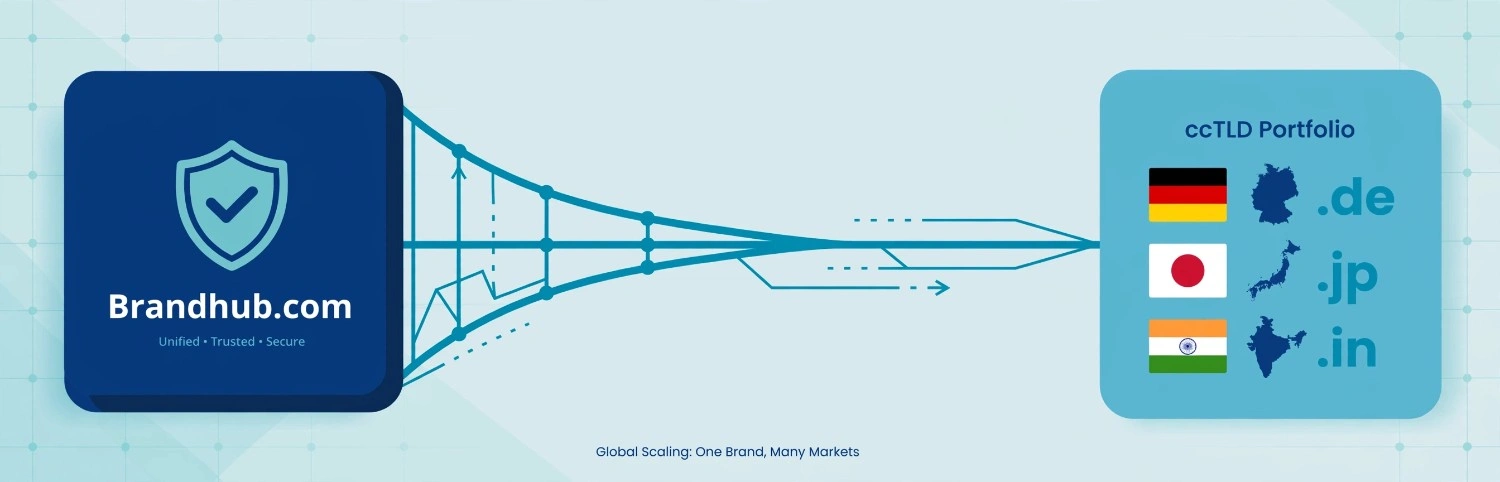
This guide walks through the two dominant approaches, how to evaluate them against your actual expansion roadmap, and the mistakes that quietly cost growing brands their search visibility.
What is a Domain Name Strategy for Global Expansion?
A domain name strategy for global expansion is the deliberate plan for how a brand structures its web addresses as it enters new countries or language markets. It typically resolves into one of three models:
- Single global domain: one one-word .com (or .co, .io, .ai) domain serving every market, often with subfolders or subdomains for language and region.
- ccTLD portfolio: a separate country-code domain purchased and hosted for each target market (for example, brand.de, brand.fr, brand.co.jp).
- Hybrid model: a primary .com domain paired with a small number of strategically chosen ccTLDs in markets with strong local-domain preference or regulatory requirements.
Each model changes how search engines index the brand, how legal teams register trademarks, and how marketing teams allocate content budgets. Consequently, this decision usually needs to be made before a single piece of localized content is written, not after.
One-Word .com Domains: The Case for Global Brand Consistency
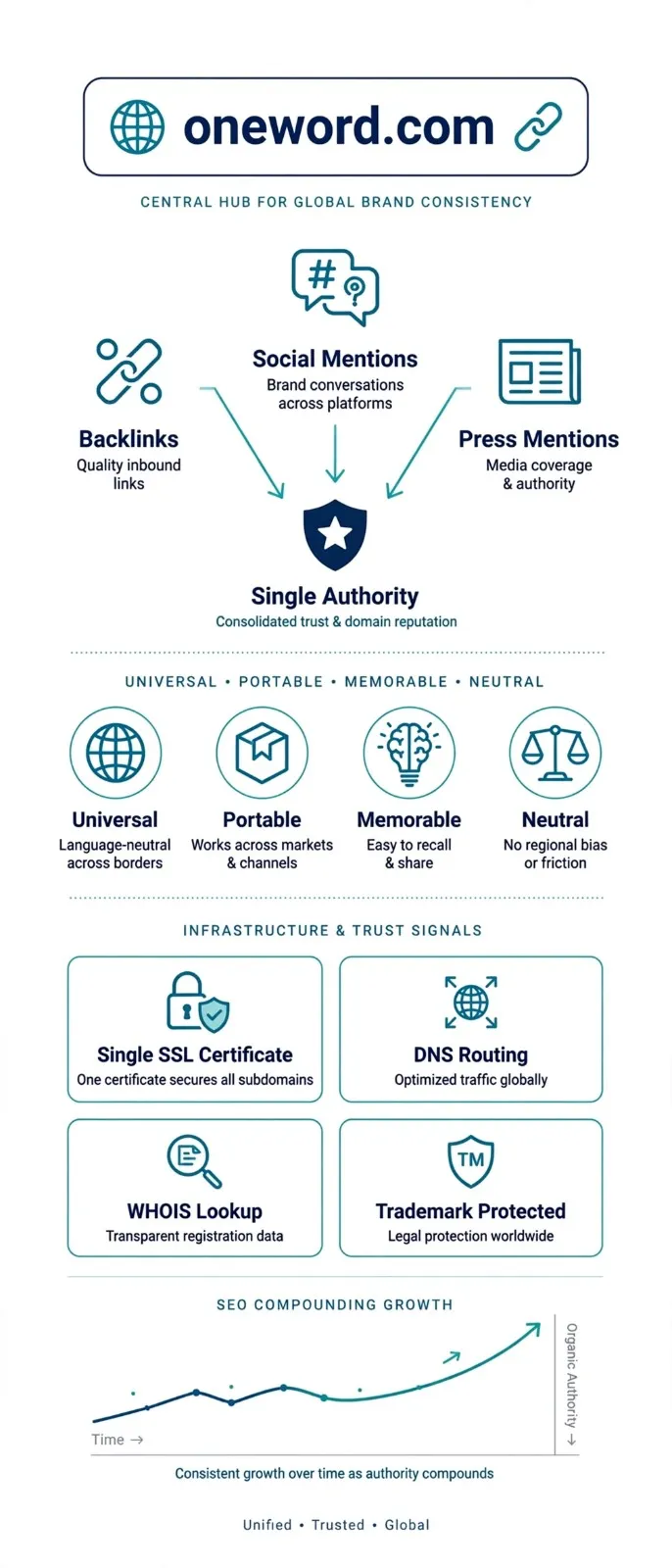
A one-word .com domain consolidates every signal, backlink, social mention, and unit of brand recall into a single address. For companies expanding into multiple markets simultaneously, that consolidation carries real, measurable advantages.
Brand Equity Stays in One Place
When a brand operates under one domain worldwide, every press mention, every inbound link, and every piece of earned media strengthens the same domain authority score. Fragmenting into ten ccTLDs means starting ten separate authority profiles from close to zero, each needing its own backlink acquisition before it ranks competitively.
Easier Cross-Border Recognition
A short, one-word .com is language-neutral in a way that localized phrases rarely are. Customers moving between countries, or discovering a brand through international social platforms, land on a familiar address regardless of which market they are browsing from. This matters increasingly as commerce becomes borderless and customers research brands across multiple country versions of Google before purchasing.
Lower Technical and Legal Overhead
Maintaining one domain means one SSL certificate, one DNS configuration, one WHOIS registration to defend, and one trademark filing strategy centered on a single mark. A step-by-step process for acquiring a one-word domain is, in practice, far simpler to execute once than to repeat across a dozen national registries with different documentation requirements.
Better Long-Term SEO Compounding
Search engines reward domains with sustained topical authority. According to Google’s own guidance on helpful, people-first content, sites are rewarded for demonstrating consistent expertise and trustworthiness over time, not for scattering thin signals across many properties. A single .com domain gives Google fewer, stronger signals to evaluate rather than many weak ones.
ccTLD Portfolios: The Case for Local Market Trust
Country-code top-level domains exist because, in some markets, local users and local search engines genuinely prefer them. Ignoring that preference in the name of simplicity can cost conversion rate even when global rankings look healthy.
Local Trust Signals
In markets such as Germany, Japan, and South Korea, consumers frequently associate a local ccTLD with a business that is legally established, tax-registered, and accountable within their jurisdiction. A generic .com can, fairly or not, read as a foreign or less committed presence.
Geo-Targeting Precision
Google Search Console allows explicit geo-targeting for ccTLDs, removing any ambiguity about which country a page should rank in. A .com domain relying on subfolders needs hreflang tags and international targeting settings to achieve a similar effect, which is achievable but requires more disciplined technical SEO maintenance.
Regulatory and Registration Requirements
Some countries legally require a local business registration, tax ID, or local hosting presence before a ccTLD can even be purchased. This is a genuine constraint, not a preference, and it shapes how quickly a brand can realistically launch in that market. The Internet Assigned Numbers Authority maintains the authoritative root zone database of ccTLD delegations and their registry requirements, which is the first place a legal or IT team should check before committing to a country launch.
Segmented Local Content
A ccTLD makes it structurally easier to run market-specific pricing, currency, promotions, and legal disclaimers without those variations bleeding into the global site’s canonical content, which can otherwise confuse search engines about which version is authoritative.
One-Word .com vs ccTLD Portfolio: Side-by-Side Comparison
| Factor | One-Word .com Domain | ccTLD Portfolio |
|---|---|---|
| Brand consistency | Single global identity | Fragmented by market |
| SEO authority | Consolidates on one domain | Split across multiple domains |
| Local trust signal | Moderate | High |
| Setup cost | Lower (one registration) | Higher (per-market registration) |
| Legal/registration complexity | Low | Often requires local entity or ID |
| Geo-targeting control | Requires hreflang and subfolders | Native, built into the TLD |
| Best suited for | Digital-first, tech, SaaS, DTC brands | Regulated industries, retail, finance |
| Long-term maintenance | Single DNS, single certificate | Multiple DNS zones, multiple renewals |
Key Factors to Evaluate Before Choosing a Domain Name for Global Expansion
Before locking in a domain name for global expansion, run the decision against these five factors:
Number of target markets.
Two or three markets can often justify a small ccTLD portfolio. Fifteen or more markets almost always favor a single .com with well-structured subfolders, purely on maintenance grounds.
Industry regulation.
Finance, healthcare, and legal services frequently face local licensing rules that make a ccTLD close to mandatory in certain jurisdictions.
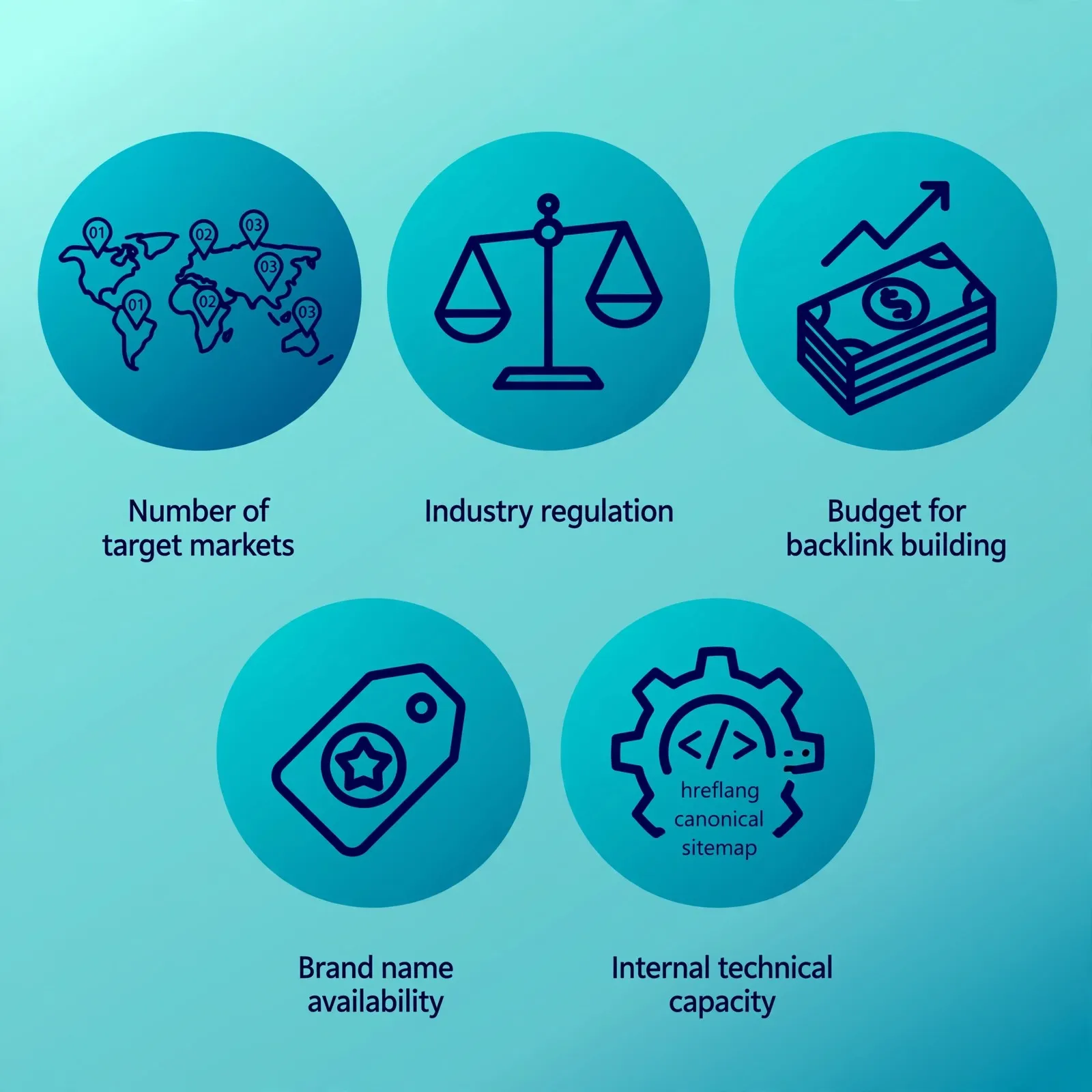
Available budget for backlink building.
A ccTLD portfolio needs its own link-building investment per domain. Underfunding that work leaves local sites under-indexed and invisible.
Brand name availability.
A one-word .com is only viable if the exact word is actually acquirable, which is why many brands work with a domain marketplace early in the planning process rather than after a launch date is already set.
Internal technical capacity.
Managing hreflang, canonical tags, and international sitemaps correctly across subfolders takes disciplined technical SEO. Teams without that capacity may find ccTLDs operationally simpler, even if they are costlier.
Step-by-Step Framework for Evaluating Your Domain Strategy
Use this sequence to move from indecision to a defensible domain plan:
Map your five-year market roadmap.
List every country you plan to enter, not just the next one, since domain architecture is expensive to reverse later.
Score each market for local-domain preference.
Research whether local consumers in that market meaningfully favor ccTLDs, using existing competitor domain structures as a proxy.
Check regulatory requirements per market.
Confirm whether a local business entity, tax ID, or physical address is required to register that market’s ccTLD.
Audit domain availability for your preferred brand word.
Verify the one-word .com is acquirable, and if not, evaluate acquisition routes through a specialized marketplace before defaulting to a compromise name.
Model the SEO authority split.
Estimate how much backlink and content investment each ccTLD would need to become competitive, and compare that to the cost of scaling one global domain with subfolders instead.
Decide on a hybrid threshold.
Set a rule, for example: “any market projected to exceed 20% of total revenue gets its own ccTLD; all others stay on the global .com.”
Document the decision for legal and IT.
A written domain policy prevents individual regional managers from registering ad hoc ccTLDs that fragment the brand later.
Brands that already own or are acquiring a strong one-word .com often benefit from reviewing a professional framework for valuing a one-word domain at this stage, since the asset’s valuation directly informs how much budget remains for the ccTLD side of a hybrid rollout.
Common Mistakes Brands Make When Expanding Domain Infrastructure Internationally
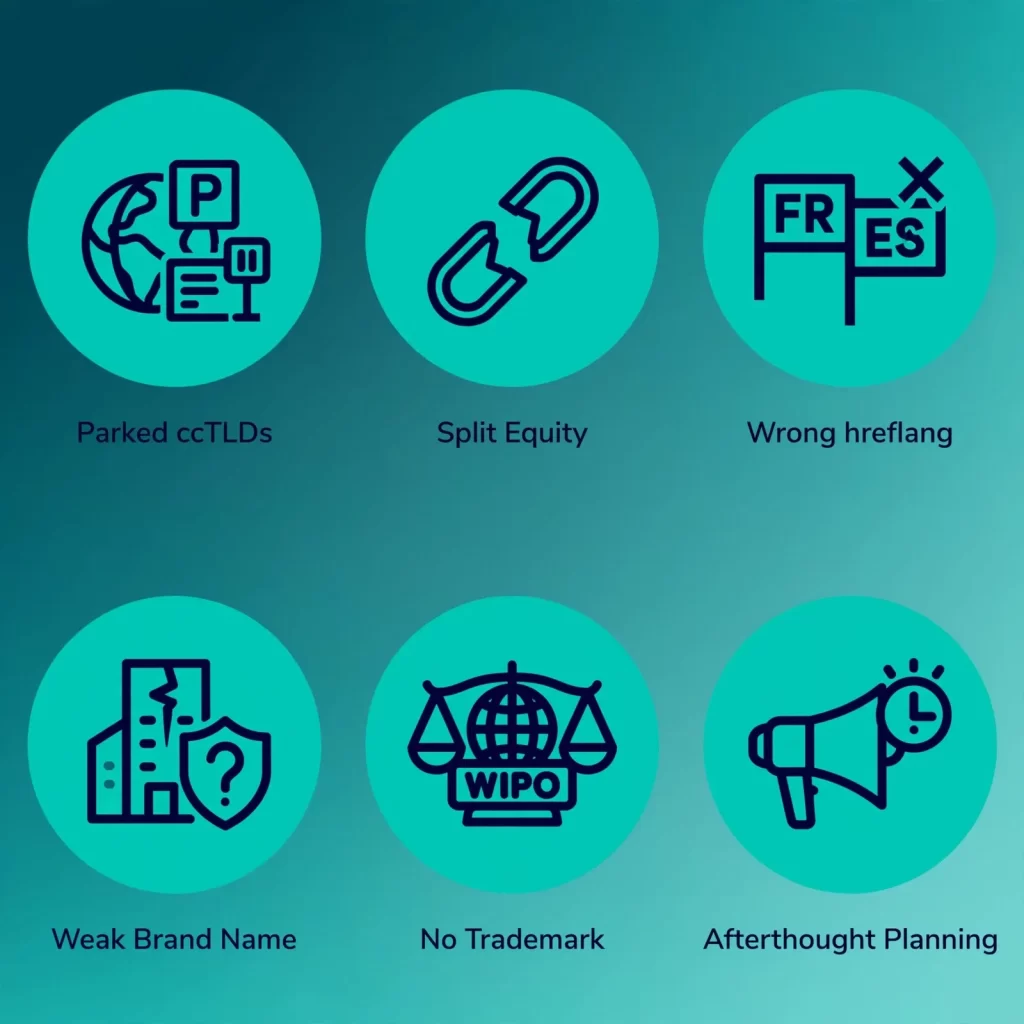
Even well-funded expansion teams repeat the same errors:
- Registering ccTLDs defensively without a launch plan, leaving dozens of parked, unindexed domains that dilute nothing but the budget.
- Splitting backlink equity too early, sending international PR coverage to a ccTLD before that market has enough content to support it.
- Ignoring hreflang implementation on subfolder structures, which causes Google to serve the wrong country version to users.
- Choosing a compromise brand name because the ideal one-word .com wasn’t secured in time, permanently weakening brand recall.
- Failing to trademark the brand name in each new jurisdiction, which can expose the domain to disputes under frameworks like the World Intellectual Property Organization’s domain name dispute resolution policy.
- Treating the domain decision as a marketing afterthought instead of involving legal, IT, and finance from the start.
Expert Tips for Building a Hybrid Domain Strategy
Most large brands eventually land on a hybrid model rather than a pure single-domain or pure ccTLD approach. A few practical tips:
Anchor everything to one strong .com
Even markets running on ccTLDs benefit from consistent backlinking to the parent brand domain to reinforce overall authority.
Reserve matching ccTLDs defensively, but redirect them.
This protects the brand from squatters without splitting SEO equity, until a market is ready for a fully built-out local site.
Use subfolders for early-stage markets, ccTLDs for mature ones
A market can graduate from a subfolder to a dedicated ccTLD once its traffic and revenue justify the added maintenance.
Keep naming identical across every domain
A one-word brand name should stay exactly the same whether the URL ends in .com, .de, or .jp; localized taglines and content can vary, the core name should not.
Budget for the word, not just the extension
The extension is the cheap part. Acquiring the right one-word .com, especially a short, dictionary-clean word, is typically the larger line item, which is why understanding what actually makes a domain “one-word” and why it matters is worth reviewing before budgeting the rest of the expansion.
Industry-by-Industry Domain Strategy Scenarios
Domain strategy does not play out the same way in every sector. The right structure often depends more on industry norms than on company size.
SaaS and digital-first products.
Software companies selling a single global product typically gain the most from a one-word .com domain, since their customers already expect to sign up and pay in one consistent place regardless of country. Localization here usually lives in subfolders (/de/, /jp/) rather than separate ccTLDs, because the product experience itself, not the domain, is what needs to feel local.
E-commerce and retail.
Retail brands face a different calculus, since shipping, currency, and returns policy genuinely differ by country. A ccTLD often communicates to shoppers that pricing, tax, and delivery are handled locally, which can measurably reduce cart abandonment in markets where consumers are wary of importing goods from a foreign-looking site.
Financial services and insurance.
These industries are among the most likely to require a licensed local entity before a business can even operate under a country’s ccTLD, let alone advertise there. In this category, the ccTLD decision is frequently made by compliance teams, not marketers, and the domain strategy has to be built around that constraint from day one.
Healthcare and medical services.
Similar to finance, medical and pharmaceutical brands often face country-specific advertising and licensing restrictions that make a dedicated ccTLD, hosted and registered locally, close to unavoidable in regulated markets.
Media, publishing, and content brands.
These brands frequently benefit most from a single strong .com, since content itself, not transactional trust,

drives the brand relationship, and consolidating readership metrics and backlinks on one domain strengthens overall authority faster than splitting audiences across ccTLDs.
Technical SEO Checklist for International Domain Rollout
Whichever structure a brand chooses, a handful of technical fundamentals need to be in place before launch:
- Hreflang tags on every localized page, pointing correctly to every language and region variant, including a self-referencing tag.
- A single canonical version per language-region pair, so search engines never have to guess which page to index.
- Country-specific XML sitemaps, submitted separately in Google Search Console for each geo-targeted property.
- Consistent internal linking between global and local versions, so authority flows both ways rather than isolating each market.
- Local server response times, since page speed remains a ranking factor and a domain served from a distant data center can quietly undercut local rankings.
- Currency, date, and legal disclaimer localization, reviewed by local counsel where applicable, particularly for finance, healthcare, and insurance verticals.
- A single, centrally maintained naming and domain-registration policy, so no regional office registers a rogue ccTLD outside the approved architecture.
Skipping any one of these can quietly undermine even a well-chosen domain structure, since Google’s international targeting signals depend on this level of technical consistency rather than on the domain extension alone.
How Domain Valuation Shapes Global Expansion Budgets
A one-word .com domain is a finite asset. Short, dictionary-real, brandable words in .com are largely already registered, which means acquiring one for a global expansion often means buying it on the secondary market rather than registering it fresh. This changes how a brand should budget:
| Domain Type | Typical Availability | Budget Implication |
|---|---|---|
| Generic one-word .com | Extremely limited | Requires acquisition, not registration |
| Brandable coined-word .com | Moderate | Cheaper, but weaker built-in search demand |
| Matching ccTLDs | Usually available | Low cost, register directly |
| Hyphenated or modified .com | Widely available | Cheapest, but weakest brand recall |
Treating the one-word .com acquisition as a strategic capital investment, rather than a marketing line item, tends to produce better long-term outcomes, since the domain itself becomes a compounding SEO and brand-recognition asset across every market the company enters afterward.
How Backlink Authority Moves (or Doesn’t) Across Domain Structures
One of the least understood parts of international domain planning is what actually happens to link equity when a brand splits across multiple properties. This is worth understanding in detail before committing to any structure, since it directly affects how fast each market can realistically compete in search.
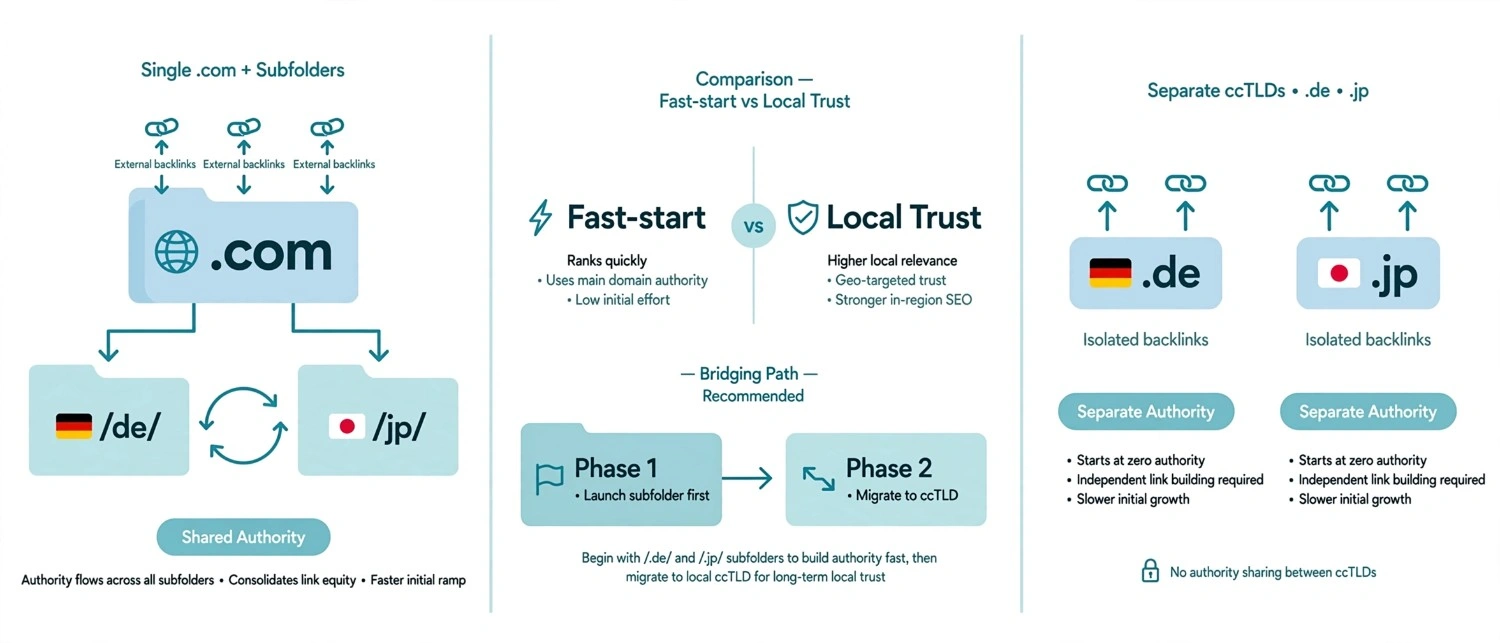
When a brand operates entirely on a single .com domain with subfolders, every backlink pointing anywhere on that domain contributes, at least partially, to the overall domain’s authority score. A press mention linking to the homepage still lends some strength to the /de/ subfolder, because search engines evaluate authority at the domain level as well as the page level. This is why brands with an established one-word .com domain often find that new-market subfolders start ranking for competitive terms faster than a brand-new ccTLD would, even with comparable content quality.
ccTLDs do not get this benefit. A .de domain is treated by search engines as an entirely separate entity from the parent .com, meaning it starts with effectively zero domain authority no matter how strong the global brand is. This is not a flaw in the ccTLD model, it is simply the trade-off for the local trust signal it provides. Brands choosing ccTLDs need to budget for local PR, local backlink outreach, and local content investment as though they were launching a brand-new website, because from a search engine’s perspective, that is exactly what is happening.
The Internet Corporation for Assigned Names and Numbers, which oversees the global domain name system, publishes ongoing guidance on how generic top-level domains like .com are structured and governed, which is a useful primary reference for legal and IT teams building a multi-year domain policy rather than relying on secondhand summaries.
A practical middle path many brands use is to launch a new market on a .com subfolder first, allowing it to inherit some domain authority while local content and backlinks are built, then migrate to a dedicated ccTLD later once the market has proven its revenue potential and local backlink profile independently. This sequencing captures the fast-start advantage of the global domain while still arriving at full local trust once the investment is justified.
Frequently Asked Questions
What is the best domain name for global expansion?
The best domain name for global expansion is typically a short, one-word .com, since it consolidates SEO authority, brand recognition, and legal protection under a single address that works across every market without translation.
Should I use a ccTLD or a .com when entering a new country?
Use a ccTLD when the target market has strong local-domain preference or a regulatory requirement, and use a .com subfolder when the market is smaller or still in an early testing phase, since subfolders are far cheaper to maintain.
Can I switch from a ccTLD portfolio to a single .com domain later?
Yes, but it requires careful 301 redirect mapping and usually causes a temporary ranking dip in each affected market, so it is significantly easier to choose the right domain name for global expansion from the outset than to migrate later.
Do ccTLDs rank better in local search results than .com domains?
Not automatically. Google can geo-target .com subfolders through Search Console settings and hreflang tags, though ccTLDs carry a built-in local signal that some users trust more, independent of rankings.
How much does a one-word .com domain typically cost for a global brand?
Pricing varies enormously by word rarity, length, and search demand, and premium one-word .com domains are usually acquired through a specialized marketplace rather than standard registration, since most such words are already owned.
Is a hybrid domain strategy more expensive than a single global domain?
Yes, a hybrid strategy costs more to maintain because it involves multiple DNS zones and renewal cycles, but it often earns back that cost through higher local trust and conversion rates in regulated or ccTLD-preferential markets.
When should a growing brand revisit its domain name for global expansion?
A brand should revisit its domain strategy whenever it plans to enter a new region with different regulatory requirements, whenever a single market grows large enough to justify its own dedicated ccTLD, or whenever the original domain choice starts creating measurable friction in local trust or search visibility, since waiting too long typically makes any later migration more disruptive.
Conclusion
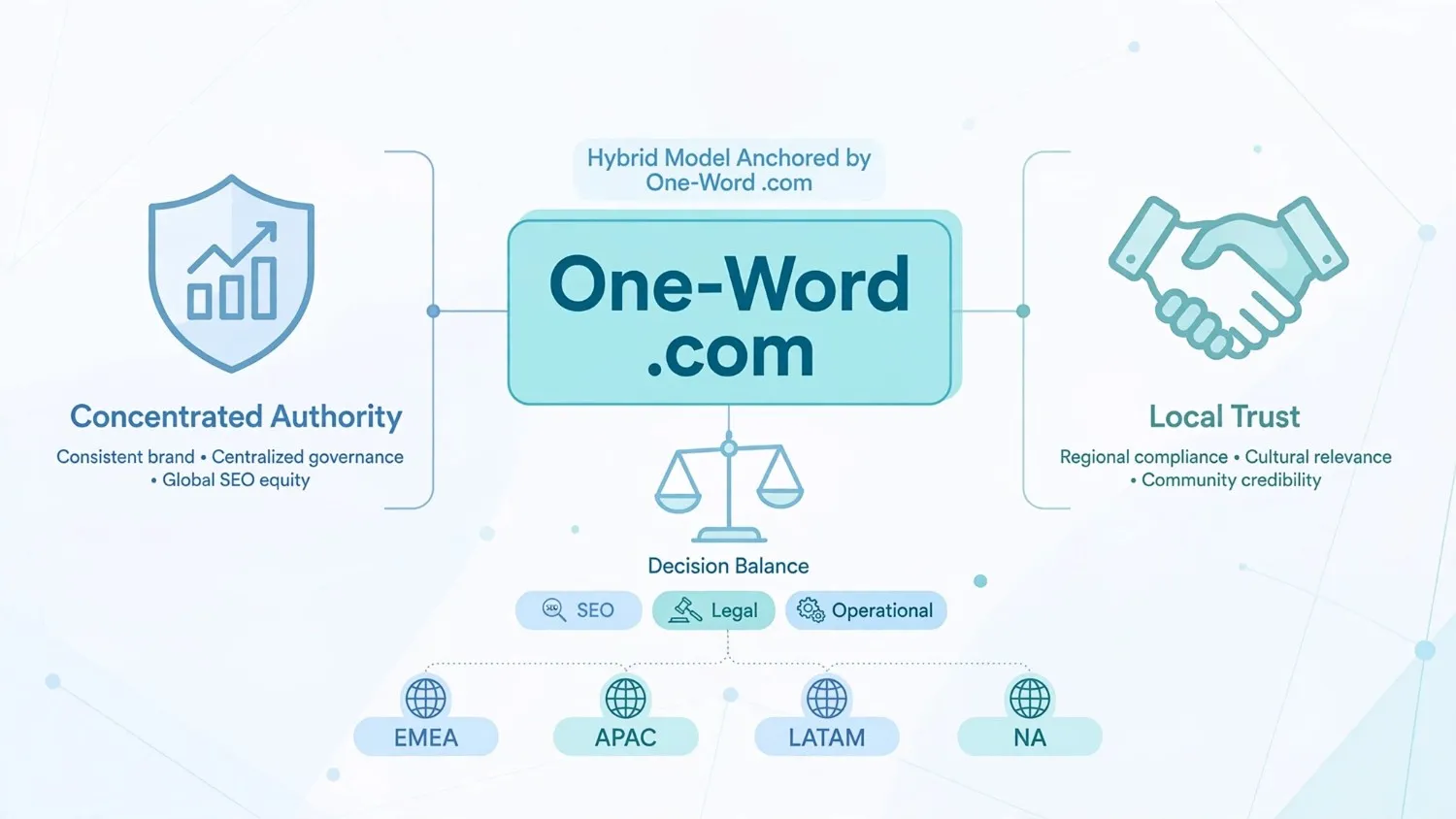
Deciding between a one-word .com domain and a ccTLD portfolio is not a branding preference; it is an SEO, legal, and operational decision that shapes how a company scales internationally. A single strong .com concentrates authority and simplifies management, while ccTLDs deliver local trust and regulatory compliance where they are genuinely required. Most brands with serious multi-market ambitions eventually converge on a hybrid model, anchored by one durable one-word domain. If your team is mapping out a global rollout, and build the naming foundation before the rest of the rollout plan is finalized.
Pingback: Startup Naming Strategy: Why One-Word Names Win