
Choosing the right domain name for podcast or media brand growth is the single decision that determines whether a show stays a hobby or becomes a licensable, multi-platform property. A one-word .com domain gives an audio brand the naming flexibility to expand into video, newsletters, merchandise, and live events without a rebrand. This structural advantage is why acquiring premium, one-word domain names early has become standard practice among media operators scaling past their first hit episode.
Podcasting has quietly become one of the most crowded media formats on the internet, and the shows that break out of the noise rarely do it by accident. Behind almost every audio brand that has grown into a full media company sits a naming decision made months or years before the growth actually happened. That decision usually involves a domain name for podcast or media brand identity that was built to stretch, not one that boxed the show into a single format.


This article walks through why that naming choice matters so much, how one-word domains specifically support multi-channel expansion, and what a practical acquisition process looks like for a creator or media operator planning to scale beyond a single feed.
What Makes a Domain Name for Podcast or Media Brand Success Different From a Regular Business Name

A domain built for a media brand has to do more work than a typical business domain. It needs to function as:
- A show title that listeners can recall and search for directly
- A publishing platform name that extends across YouTube, newsletters, and social audio
- A licensing asset that can carry sponsorship deals, spin-off shows, and merchandise lines
- A trust signal for advertisers evaluating the brand’s staying power
Traditional business domains are usually optimized for one purpose: describing what a company sells. Media brand domains carry a different burden. They need to feel like a title, not a description, because audiences relate to hosts and shows the way they relate to magazines or television networks, not software products.
This is precisely where one-word domains outperform descriptive alternatives. A name like a single evocative word reads as a brand from day one, whereas a hyphenated or keyword-stuffed domain reads as a landing page.
The Podcast Growth Trajectory: From Audio Show to Multi-Channel Empire

Most successful media brands follow a fairly predictable expansion path, even when the content categories differ wildly:
- Single-format launch – the show begins as audio-only, distributed through podcast apps.
- Video simulcast – episodes get recorded on camera and published to YouTube alongside the audio feed.
- Newsletter or blog layer – written content captures search traffic and builds an owned email list.
- Community and live events – Discord servers, meetups, and ticketed live tapings extend the relationship beyond passive listening.
- Merchandise and licensing – the brand name becomes a product line, sponsorship vehicle, or franchise.
Each stage adds a new content format under the same brand umbrella. A domain name for podcast or media brand identity chosen at stage one needs to still make sense at stage five. That’s a naming problem most creators underestimate until they’ve already built an audience around a name that only works for audio.
Why One-Word Domains Outperform Show-Specific URLs for Media Expansion

Descriptive podcast URLs – the kind stuffed with words like “talk,” “show,” or a niche keyword – tend to work well for search discovery early on but become a liability as the brand diversifies. A single clean word avoids that trap entirely.
| Factor | One-Word Domain | Descriptive/Keyword Domain |
|---|---|---|
| Format flexibility (audio, video, newsletter) | High – name isn’t tied to “podcast” or “show” | Low – often locked into audio framing |
| Brand memorability | Strong, functions like a title | Weaker, blends into generic niche terms |
| Licensing and spin-off potential | Easy to extend (e.g., sub-brands, verticals) | Harder, name already narrowly scoped |
| Trademark and legal clarity | Cleaner, less generic-term conflict | Higher risk of genericness disputes |
| Resale and enterprise value | Appreciates as a standalone brand asset | Tied to niche relevance, less liquid |
| SEO for brand-name searches | Very strong once brand recognition builds | Initially stronger for keyword search, fades in value |
The trade-off is real: keyword-rich domains can capture early organic search traffic more easily, since the domain itself hints at the topic. But media brands that intend to grow past a single show typically find that brand-name search volume eventually eclipses topical keyword search – and at that point, a one-word domain becomes the far more valuable asset.
Step-by-Step: Choosing and Acquiring a One-Word Domain for Your Media Brand

Selecting a domain name for podcast or media brand purposes benefits from a structured process rather than a spontaneous pick. Here’s a practical sequence:
Step 1: Define the brand’s five-year format map.
List every channel you realistically expect to launch – video, newsletter, live events, merch – and check the candidate name against each one mentally.
Step 2: Shortlist words with emotional or thematic resonance
Shortlist words with emotional or thematic resonance, not literal descriptions. Titles that evoke a feeling tend to age better than titles that describe a genre.
Step 3: Check availability and ownership history.
A domain with a clean registration history avoids inherited SEO penalties or brand confusion.
Step 4: Evaluate pronounceability and spelling.
Anything requiring on-air spelling (“that’s B-R-A-N-D with two D’s”) loses listeners at the exact moment they’re most motivated to visit.
Step 5: Confirm trademark clearance
Confirm trademark clearance for your content category before committing budget to the acquisition.
Step 6: Negotiate or acquire through a reputable marketplace
Negotiate or acquire through a reputable marketplace rather than cold outreach, to reduce fraud risk and speed up transfer timelines. Reviewing a step-by-step process for acquiring a one-word domain before entering negotiations helps set realistic pricing expectations.
Step 7: Secure matching handles
Secure matching handles across major social and podcast platforms immediately after acquisition, before announcing the brand publicly.
Skipping steps 3 and 5 is the most common source of expensive naming mistakes – creators fall in love with a word, acquire it, and only later discover a trademark conflict or a domain history riddled with spam penalties.
Common Mistakes Podcasters Make When Naming Their Media Brand
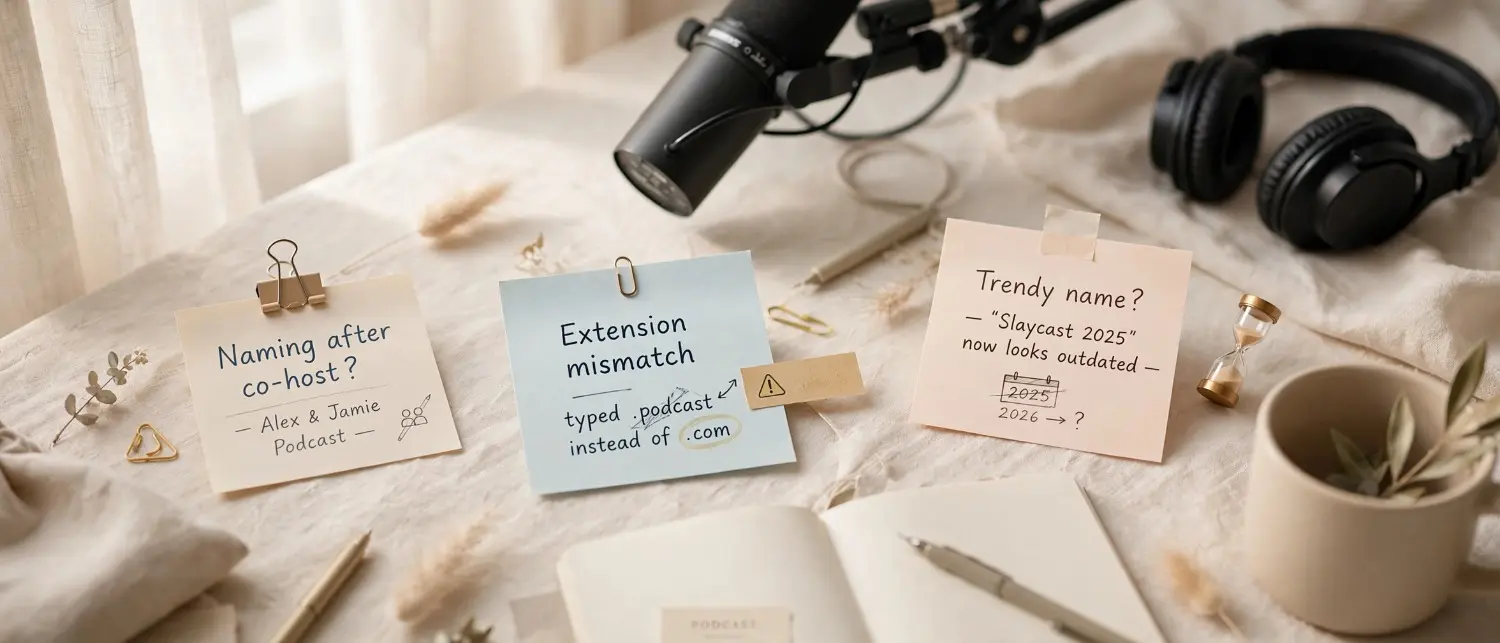
Even experienced creators repeat a handful of avoidable errors:
- Naming the show after a single co-host who may eventually leave the project, orphaning the brand equity.
- Using a domain extension mismatch, where the “official” site sits on a less-trusted extension while a squatter holds the .com.
- Choosing a name that’s too literal to a current trend, which dates the brand once the trend fades.
- Delaying domain acquisition until after the show gains traction, by which point the ideal one-word option is often already taken or priced far higher.
- Underestimating international expansion needs, then discovering the brand name conflicts with an existing trademark or negative meaning in a target market.
Expert Tips for Domain-First Brand Architecture

Operators who treat the domain as a foundational business asset – not just a URL – tend to build more durable media properties. A few patterns worth adopting:
- Treat the domain acquisition budget as part of your launch capital, not an afterthought purchase.
- Prioritize domains with clean backlink and indexing history, since a previously spammed domain can suppress early search visibility.
- Build a lightweight valuation checklist before negotiating, covering length, brandability, extension, and market comparables – a full framework for valuing a one-word domain is useful groundwork here.
- Keep legal and creative teams aligned early, since trademark clearance and creative naming often pull in opposite directions.
- Plan the sub-brand naming convention (spin-off shows, verticals) before you need it, so growth doesn’t force an awkward retrofit.
Quick Answer: What’s the Ideal Domain Length for a Podcast Brand?
Short answer: one word, ideally under three syllables, with no hyphens or numbers. This maximizes recall, minimizes spelling errors during word-of-mouth referrals, and keeps the name flexible enough to support future sub-brands and product lines.
One-Word .com vs ccTLD for Global Podcast Expansion
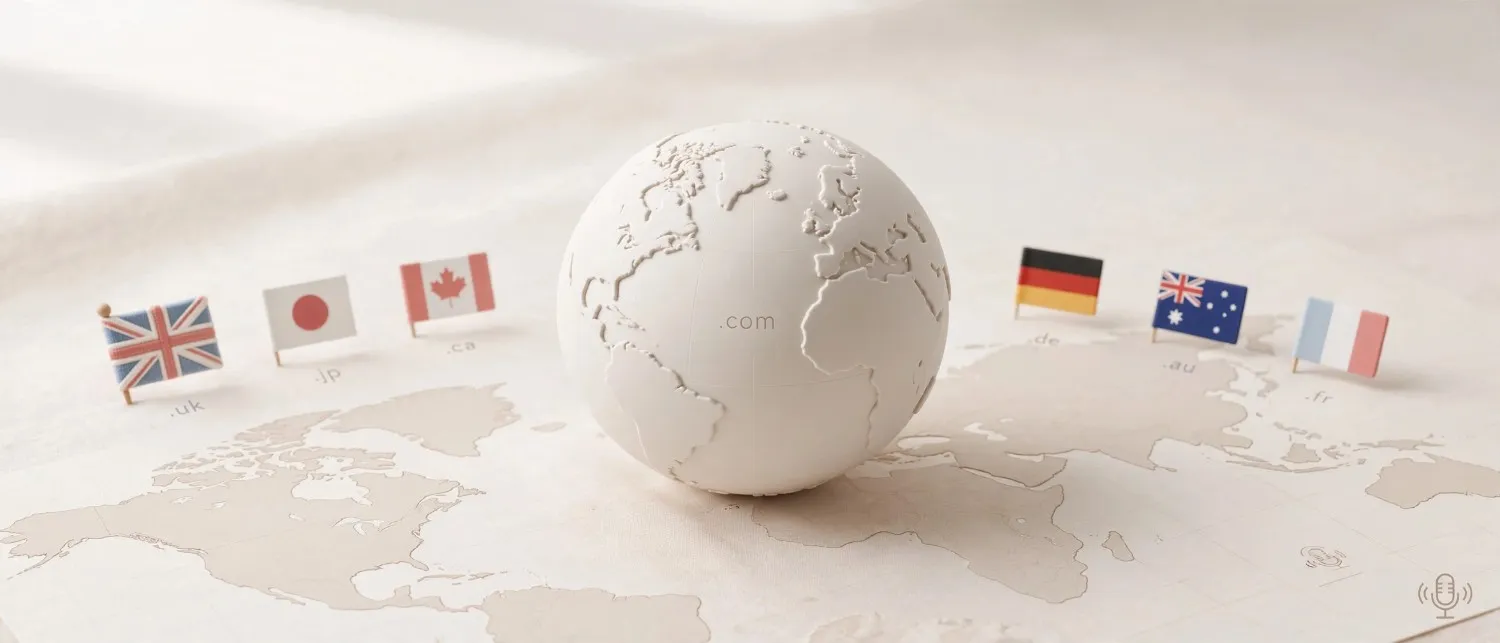
Shows that plan to build an international audience face an additional naming decision: whether to anchor the brand on a .com or lean into a country-code extension for specific markets. For most media brands, a one-word .com remains the stronger global anchor, since it avoids signaling a single-country focus and keeps licensing negotiations simpler across territories. Creators weighing this trade-off in more depth may find a detailed comparison of global brand expansion strategy for one-word .com domains versus ccTLDs helpful before locking in an international rollout plan.
Building a Portfolio: Beyond Your First Domain
Once a media brand has validated its core show, many operators start acquiring adjacent one-word domains – defensive registrations, sub-brand names, or entirely new verticals under the same parent company. This is where naming strategy shifts from a single decision into ongoing portfolio management. A structured approach to building a diversified one-word domain portfolio prevents scattershot acquisitions and keeps the brand’s naming assets coherent as the media company grows.
What Exactly Qualifies as “One Word”? A Quick Clarification
Not every short domain counts as genuinely one-word from a branding standpoint. Compound terms, portmanteaus, and invented words all fall into different categories with different strengths. For podcast and media brands specifically, understanding what exactly makes a domain one-word and why it matters helps avoid overpaying for a domain that only looks premium at first glance.
Featured Snippet Summary: Domain Naming Checklist for Media Brands
- Choose a single word with no hyphens, numbers, or niche-specific terms
- Confirm the word works across audio, video, newsletter, and live event formats
- Verify trademark clearance in your primary content category
- Check the domain’s registration and indexing history before purchase
- Secure matching social and podcast platform handles immediately after acquisition
- Budget domain acquisition as part of your initial launch investment, not a later expense
FAQ

What makes a good domain name for a podcast or media brand?
A good domain name for podcast or media brand growth is short, easy to spell by ear, free of hyphens or numbers, and not narrowly tied to a single content format. One-word domains typically meet all four criteria.
Should I buy a one-word domain before or after my podcast gains traction?
Before, if possible. Prices and availability for strong one-word domains only get worse once a show gains an audience, and rebranding a growing show carries real audience-retention risk.
Can a one-word domain really support video and newsletter expansion, not just audio?
Yes. Because the name isn’t tied to “podcast” or “show” terminology, it functions as a neutral brand anchor that fits any content format the media company later adds.
Is a keyword-rich domain better for SEO than a one-word brand domain?
Keyword-rich domains can capture some early topical search traffic, but brand-name search volume typically overtakes topical search once a media brand grows – at which point a one-word domain holds more long-term value.
How do I check if a one-word domain has SEO or trademark issues before buying?
Review the domain’s registration and indexing history, run a trademark clearance search in your content category, and work through a marketplace that discloses domain history rather than buying blind.
Do I need a different domain name for each spin-off show?
Not necessarily. Many media brands use sub-paths or sub-brand names under the primary one-word domain, reserving separate acquisitions for genuinely distinct verticals.
Conclusion




A show’s content is what earns the audience, but the domain name for podcast or media brand identity is what determines how far that audience can follow you. One-word domains give creators the structural flexibility to add video, newsletters, live events, and licensing deals without ever needing to rebrand mid-growth – a constraint that descriptive, keyword-heavy domains simply don’t offer. For operators serious about turning a single show into a lasting media property, before the brand outgrows its current name is one of the highest-leverage decisions available this early in the process.
Pingback: One Word Domain for E-Commerce Store: Cut Bounce Rate